"I press on toward the goal to win the prize for which God has called me heavenward in Christ Jesus." — Philippians 3:14
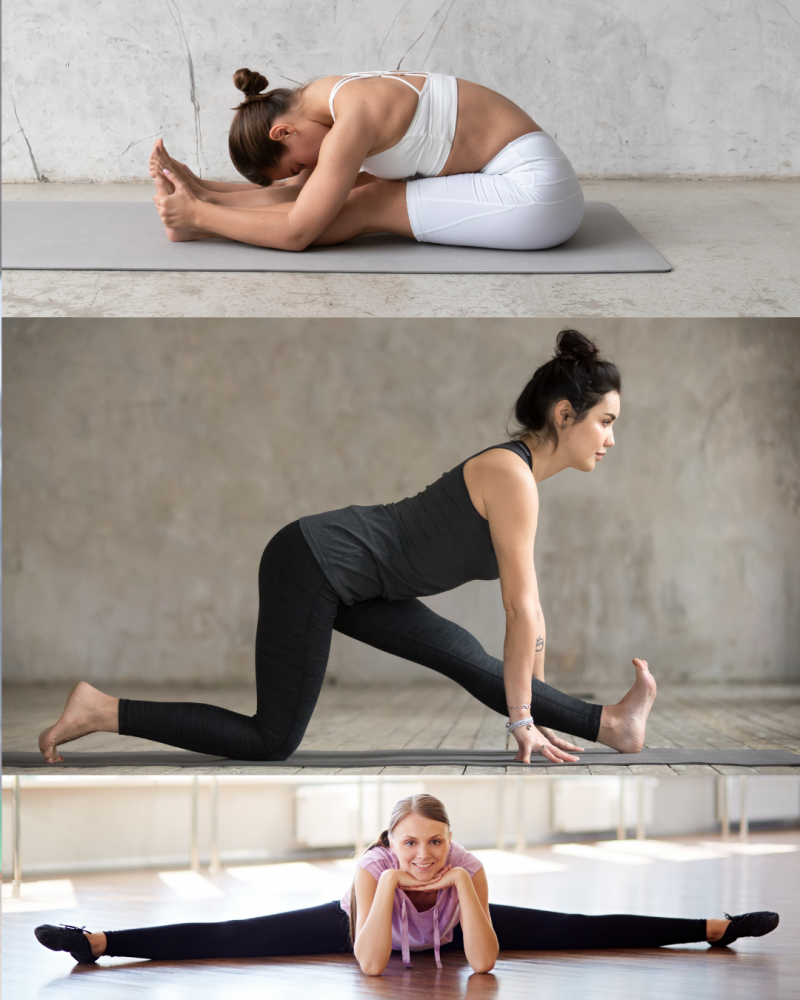
This week, we're finishing out our floor conditioning series by going straight to the hips — and if you've ever wondered why some aerialists seem to move through a straddle, a split, or a deep back-bend with ease while others fight for every inch, the answer usually lives right here.
I'll be honest — this one is personal for me. My pancake and my splits have been a lifelong nemesis. For years I genuinely could not understand why I couldn't get there, and honestly, as I've gotten older it's still a real struggle at times. It IS getting better, though, the more consistently I work on strengthening my body — which, frankly, surprised me. You'd think that with my hypermobility, splits would be effortless. But it turns out my body has its own protective logic at work: my nervous system has quietly set boundaries around how far it believes my muscles can safely stretch, regardless of how much range my joints technically have available.
As it turns out, there's real research behind this. Hypermobile joints often have more laxity in the ligaments and connective tissue than they have reliable proprioception — meaning the brain's sense of exactly where that joint is in space becomes less accurate. When the brain can't fully trust its own positional feedback, it responds by increasing background muscle tension around that joint as a protective strategy, sometimes called muscle guarding. The result is a body that can be hypermobile and feel tight or stuck at the same time — because the restriction isn't coming from short muscles, it's coming from a nervous system that hasn't yet learned it's safe to let go. The encouraging part of this research is that it's changeable: building strength and control through the joint's full range — not just stretching harder — is what teaches the nervous system that the position is safe, which is exactly why strengthening has moved my splits forward more than stretching ever did on its own.
If any of that sounds familiar, I want you to hear this: it isn't a flaw, and it isn't you doing something wrong. It's your body being smart and protective. And the strength work in this post is exactly how you teach it to trust you a little more.
Hip strength and hip mobility aren't two separate goals. They're the same goal, approached from two directions. You can't safely access a new range of motion without the strength to control it once you're there — and you can't build meaningful strength in a joint if you don't have the mobility to move it through its full range in the first place. For aerialists specifically, this relationship isn't optional. Every extended leg line, every straddle inversion, every held split on the fabric asks your hips to be strong at the end of their range, not just in the comfortable middle of it.
The Science Behind It: Hips, Glutes, and Range of Motion
Your hip's mobility and stability both run largely through two muscle groups: the gluteus maximus and the gluteus medius. The glute max is your primary hip extensor — the big engine behind straightening and driving the leg back. The glute medius sits more laterally and controls the hip in the frontal and rotational planes, stabilizing your pelvis any time you're on one leg, inverted, or moving your leg out to the side.
Anatomical research has actually mapped this relationship directly: as the hip moves further into flexion, the gluteus medius tendon experiences significantly more excursion — meaning the muscle is required to lengthen and travel through more range the deeper into hip flexion you go. In practical terms, that means the more range of motion you ask your hip to move through, the more this muscle has to actively lengthen and manage that motion, rather than just holding a fixed position.
And this isn't just theoretical. A study on hip flexibility interventions found that a daily stretching and mobility routine measurably improved both hip flexibility and gluteal muscle function together, over just a few weeks — supporting exactly what we're talking about here: mobility work and glute function move together, not separately. You don't get a flexible hip and a strong glute as two unrelated wins. You build them as one system.
That's exactly why the majority of this week's resources use resistance bands. Bands are uniquely good at building strength through a joint's full range of motion, including that outer edge where most of us are weakest — which is precisely the range aerial asks you to hold with strength, not just reach into and hope for the best.
The Resource List
Foundational Hip Mobility Guides
Start here if you want to understand the full picture before diving into specific workouts.
- Resistance Band Mobility Exercises: Enhance Joint Range Through Loaded Movement
- Gymnastics – Training and Conditioning Using Resistance Bands
- 14 Exercises for Strengthening and Increasing Mobility in the Hips
- Comprehensive Guide: 20 Hip Exercises for Strength and Mobility
Gymnast & Dancer Band Workouts
Built for bodies asking the same things of their hips that ours are.
Hip Range of Motion & Rotation
For understanding and training the joint itself — not just the muscles around it.
- How To Improve Your Hip Range of Motion — E3 Rehab
- The Secret Hip Mobility Hack
- Hip Internal and External Rotation Exercise
Straddle & Pancake Flexibility
For the specific range of motion so much of aerial choreography depends on.
- Your Body is Failing in 4 Places — That's Why the Pancake Is Impossible
- 6 Active Flexibility Drills for Your Straddle Pancake — Dani Winks Flexibility
- Resistance Band Stretches for Splits
Glute Strength & Activation
Because a mobile hip still needs a strong, well-activated glute complex to control it.
- 15 Best Abductor Exercises Backed by Science & Trainers
- Resistance Band Workout for Hips and Glute Activation
- 12-Minute Resistance Band Hip Workout and Stretch
- 4 Strengthening Exercises for Gluteus Medius
- Resistance Band Glute Workout: Strengthen & Tone Your Glutes
How to Actually Use This List
If you're new to band work, start with the Foundational Guides section to understand the mechanics, then pick one Glute Strength video and one Straddle & Pancake Flexibility resource to rotate into your week. A resistance band is a small, inexpensive investment that will pay off in every extended leg line, every straddle, and every held position you ask your body to hold with control — not just reach into and hope it stays. Plus, it's small and easy to pack so you can take it with you when you travel.
This wraps up our three-part floor conditioning series — core, inversions, and now hips. Taken together, these three areas cover the foundation nearly every aerial skill is built on. Go back through all three if you haven't yet, and remember: this work compounds. Every session you put in on the floor shows up in the air.
Peggy Ployhar Owner, Eternal Aerial Arts
Add comment
Comments