"Let us not become weary in doing good, for at the proper time we will reap a harvest if we do not give up." — Galatians 6:9
If you've ever hung there — knees bent, straddle half-open, legs just refusing to lift past your hips — and felt like your invert would never come together, I want you to know something first: you are not alone, and you are not behind. Inverting is, without exaggeration, one of the most commonly struggled-with skills in all of aerial arts. It's not a sign that something is wrong with you. It's a sign that inversion asks a lot of the body, all at once, and most of us simply haven't trained those pieces together to create the strength and muscle memory to make an invert naturally happen repeatedly.
This is the second post in our conditioning series (if you missed last week's on core strength and injury prevention, go check that out too — it's the foundation everything else builds on). This week, we're going straight at inversions: what actually makes them hard, and a full library of floor resources to help you build the strength to get there.
Why Inversions Are So Hard — And Why That's Okay
An invert isn't one muscle group doing one job. It's several systems firing together, in sequence, under load. Your hip flexors — mainly the iliopsoas and rectus femoris (in layman's terms a muscle group in your quads and muscles that cause a pelvic tilt)— are doing the work of lifting your legs up and in toward your torso. But hip flexors can't do that job well on their own. Research on inversion mechanics is consistent on this point: the hip flexors need a stable anchor to pull from, and that anchor is your core — without a solid core, the muscles doing the lifting become far less effective, no matter how strong they are in isolation.
At the same time, your upper body is doing its own job — pulling and stabilizing so your hips even have something to invert around. Vertical pulling strength holds your body weight off the ground as your legs lift, and horizontal pulling strength (through the mid-traps and rhomboids) helps stabilize your shoulder blades, so the whole position holds together instead of collapsing. And underneath all of it, your hip flexors need a healthy amount of length as well as strength — tight hip flexors limit how far your legs can travel, no matter how strong they are.
So, an invert is really asking four things to show up at once: a strong, stable core; strong and mobile hip flexors; upper body pulling strength; and coordination to bring it all together in the right sequence. That's a lot! Which is exactly why floor conditioning — done consistently, off the apparatus, where you can isolate and build each piece — makes such a difference.
Here's the encouraging part: this is trainable. Every piece of that list responds to consistent, patient work. An invert that feels impossible today is genuinely just a few months of the right conditioning away for most students. It is a worthy endeavor, and it pays off — not just in that one skill, but in how much more capable, controlled, and confident you feel across everything else you do in the air.
The Resource List
Core & Body Mechanics for Inversions
- Inversion Drill: Core — Aerial Fit Online — A full page of core-focused floor exercises built specifically around the demands of inverting.
- Inversion Drill: Upper Body Floor Exercises — Aerial Fit Online — The companion piece to the above, focused on the upper-body pulling strength your invert also depends on.
Pilates for Inversion Strength
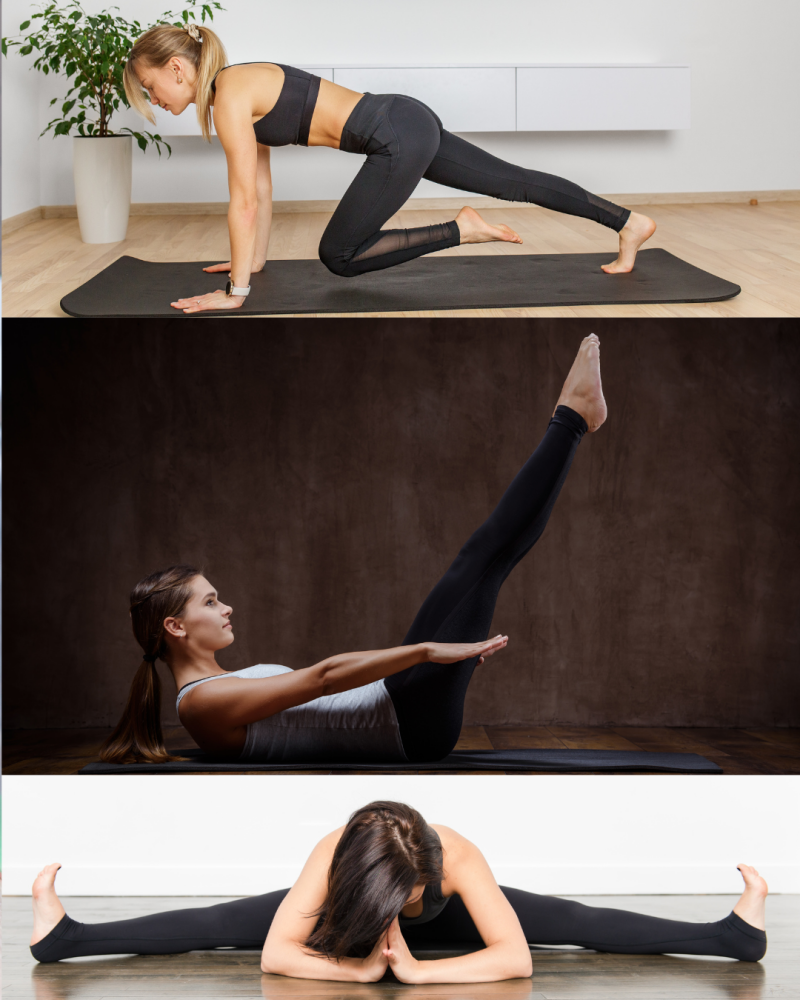
Classical Pilates was basically built for this — deep core control, precision, and full-body coordination.
- Pilates 100 — A foundational core-activation exercise, great as a warm-up or building block.
- Pilates Straddle Roll Overs
- Pilates Criss Cross
- How to Do Double Straight Leg Stretch
- The Original 34 Pilates Exercises — The full classical sequence, for anyone who wants to build a complete Pilates practice alongside their aerial training.
Aerial-Specific Inversion Training — Kerri Kresinski
- Straight-Arm Straddle Inversion Exercises — Mostly floor-based, with a few apparatus exercises included.
- Do Straddle Ups w/ Straight Knees! — Floor work focused on straddle ups with a straight-knee emphasis.
- Straddle Inversion Technique, Part 1 — The floor-based portion of her straddle inversion technique series.
- Stretching Your Straddle — Flexibility works to widen your straddle, which directly opens up your straddle inversion.
Small & Round — Ball/Straddle Invert Strengthening
- Aerial Inversions 101: Small and Round — Lauren Kehl — Walks through lower-back and pelvic tilt strengthening to help tighten up a ball or straddle invert.
Aerial-Specific Inversion Training — FitFrenchKiss
- Unlock Your Inverts Faster | Anchored Reverse Crunch for Aerialists — A targeted floor drill for the anchored reverse crunch, built to speed up invert progress for aerialists.
Gymnastics Foundations
- Sportplan — Gymnastics Coaching Drills — A free membership site with hundreds of gymnastics drills and videos. Excellent cross-training for the body awareness and strength that inversions rely on.
Full Course
- Aerial Inversion Explainer — The Circus Doc — A free course that breaks down inversion mechanics in depth. If you want the full "why," start here.
How to Actually Use This List
Don't try to do everything on this list in one sitting — pick one core/Pilates resource and one aerial-specific resource and rotate them into your conditioning two to three times a week. Consistency here matters more than intensity. Your invert isn't going to arrive from one big push; it's going to arrive from small, repeated deposits of strength and mobility work, the same way it does for every aerialist who's ever gotten there before you.
And if you're in the thick of the struggle right now — hang in there. Every single one of us who inverts cleanly today started exactly where you are.
Peggy Ployhar Owner, Eternal Aerial Arts
Add comment
Comments