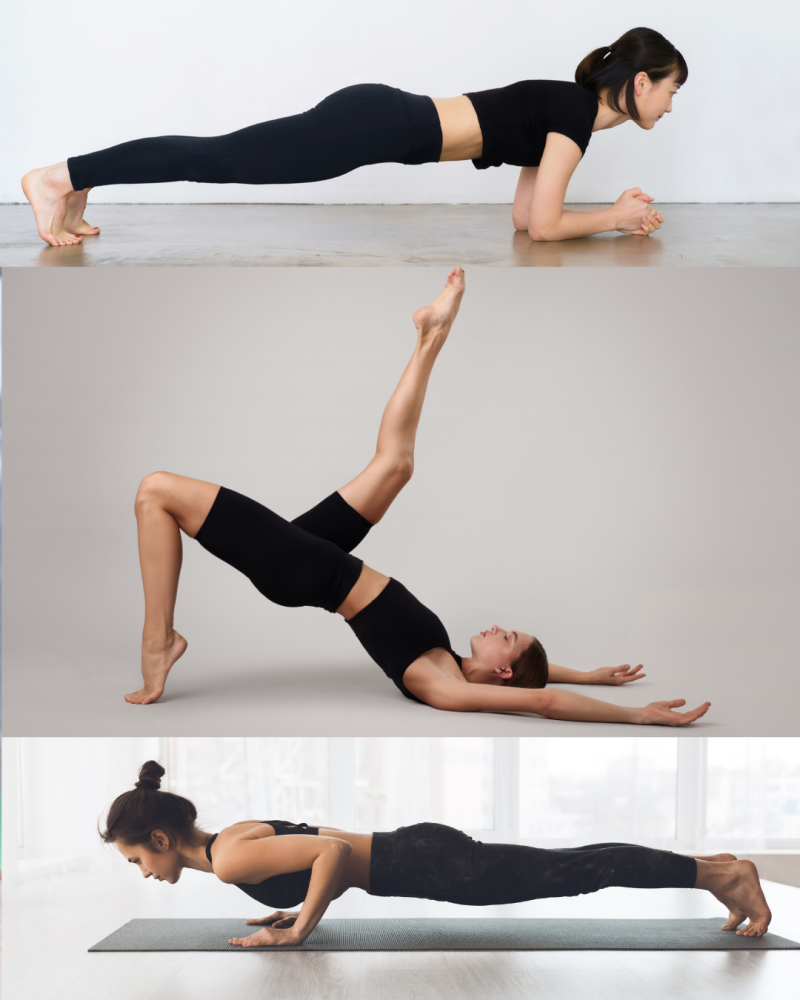
"She is clothed with strength and dignity... she sets about her work vigorously; her arms are strong for her tasks." — Proverbs 31:25, 17
There's something fitting about those verses from Proverbs 31 for aerialists. Strength isn't decoration — it's the thing that lets us do our work safely, with dignity, and without our bodies paying the price for what our ambition asks of them. And nowhere is that truer than in the core.
If you've been in the studio with me for any length of time, you've heard me say it more times than you'd probably like: your core is more than your abs. The core is the whole cylinder — front, back, sides, top, and bottom — and it's the thing standing between a controlled drop and a floppy uncontrolled one, between a wrap that holds and a wrap that slips, between a strong session and a strained one.
This week I want to hand you a full toolkit: floor-based conditioning resources — videos and reading — that you can use at home, before class, or on cross-training days to build the kind of core strength and endurance that keeps you safe in the air. But before we get to the list, let's talk about why this matters so much more for aerialists than for the average gym-goer.
Why Core Strength Isn't Optional in This Sport
Research on athletic injury consistently points back to the same structure: the core. A review in the journal Physical Therapy in Sport looked at the connection between core stability and lower-extremity injury risk in athletes, and the pattern held — athletes with lower core strength across the abs, hips, and lower back faced a higher risk of injury, and neuromuscular control — how well the brain and muscles coordinate movement — played a role as well. That second part matters as much as the first: it's not just about how strong your abs are in isolation, but whether your core fires automatically and on time when your body needs it.
That's the piece that translates directly to what we do on silks, lyra, hammock, straps and rope. Research on core dysfunction has found that in many cases the problem isn't a lack of raw strength at all — it's a breakdown in muscle recruitment, meaning the timing, amplitude, and endurance of activation. In plain terms: you can have strong abs and still get hurt, if your core doesn't switch on at the exact moment your body needs it to hold a hollow body or c-shape to keep tight in a wrap. Other research on trunk stability describes the core as forming a rigid, supportive structure that gives your limbs a stable base to move from — the muscles of the core act like a stabilizing cylinder that provides the foundation for strength and movement in the arms and legs.
Now picture what we ask of that system in the air. A controlled drop is a deceleration problem — your core has to brace and absorb force in a fraction of a second. A held wrap is an endurance problem — your core has to stay engaged, quietly, for far longer than it wants to. And when the core doesn't do its job, the body borrows strength from somewhere else: the shoulders, the low back, the wrists, the neck. That's when we see the overuse injuries and strain patterns that have nothing to do with the trick itself and everything to do with which muscles were doing the work that the core should have handled.
This is exactly why floor conditioning matters as much as your time on apparatus. You're not doing ab workouts to look a certain way — you're training your nervous system to activate the right muscle group, instantly, under load, every single time.
The Resource List
I've organized these from general foundation-building up to aerial-specific and advanced. Bookmark this post — it's meant to be a resource you come back to, not something you consume once.
Foundational Core Building
- 15 Best Ab Exercises — A beginner-to-advanced progression of core exercises. Great starting point if you're building a home conditioning habit from scratch.
- Advanced Core Exercises — The Prehab Guys — Written and video content from a team of physical therapists. Excellent for understanding the why behind each movement, not just the what as well as great instructional videos that go from beginner to advanced options for each exercise.
Aerial-Specific Core Training — Kerri Kresinski
Kerri trains aerialists specifically, which means these are built around exactly the demands we're talking about: bracing, holding, and controlling body weight through space.
- Core Strength and Endurance for Aerialists
- Core Strength and Endurance for Aerialists 2
- Core Strength for Beginner Aerialists
- Core Strength for Aerialists (2023 Update)
General Athletic Core Conditioning — CaliMove
Not aerial-specific, but excellent for building raw strength and control that transfers directly to what we do.
- The 3 Hardest Core Exercises You'll Ever Try
- How to Fix Weak Abs
- 4-Minute AB Workout Everyone Can Do!
Aerial-Specific — Womack and Bowman
Professional aerialists sharing conditioning drills built for our exact sport.
Aerial-Specific — Karin (@karinodermattcoach)
A great rotating library if you want variety — mix and match these throughout the week.
- Conditioning and Stretching at Home for Aerialists
- 5 Minutes: Intense Core Exercises, At-Home Workout
- Core/Abs Workout for Beginners and Intermediates
- Get Abs Like an Acrobat
- At-Home Core Workout
- Super Core Conditioning with a Chair
How to Actually Use This List
Don't try to do all of it at once. Pick one aerial-specific video and one general-strength video, and rotate them into your week two to three times, outside of class. Consistency on the floor is what shows up in the air — a strong hold in a wrap, a beautifully controlled drop, a session that ends without your shoulders or low back screaming at you.
And if you're not sure where to start, ask your instructor. Part of what we're building here — as a team, as a studio — is a culture where conditioning isn't an afterthought squeezed in before tricks. It's the foundation your aerial skills stand on.
Train smart, aerialists. Your body — and your studio time — will thank you.
Peggy Ployhar Owner, Eternal Aerial Arts
Add comment
Comments