A few weeks ago, I came across a question in an aerial studio owner group that I haven't been able to shake. Someone asked, essentially, how the rest of us keep our studios afloat, and whether there were specific classes we'd seen that reliably grow a business. It's a fair question. It's an honest question. Anyone who has signed a lease, ordered rigging hardware, or made payroll during a slow month has asked some version of it, myself included.
But the more I sat with it, the more I realized the question itself reveals something about how a lot of us, myself once included, have been taught to think about growth. The unspoken assumption underneath "what classes will grow my business" is usually this: identify what sells, build more of what sells, and let the highest-revenue programs become the gravitational center the rest of the studio orbits around. It's not a malicious approach. It's often just survival. But over time, it does something subtle and significant. It lets the cash register set the culture. The programs that make the most money become the programs that get the most attention, the best time slots, the most marketing dollars, the most say in who the studio becomes. Everything else, including the quieter and more impactful work in, gets sidelined into whatever space is left over.
I want to tell you, plainly, that this is not how I've chosen to build Eternal Aerial Arts.
That doesn't mean I'm cavalier about money. I am not. I know exactly what it costs to run this studio, down to the dollar, and I carry that weight the same way any owner does. But early on, I made a decision that I have had to keep making, over and over, every season since: I was not going to let revenue projections be the primary architect of this studio's growth plan. Instead, I committed to starting somewhere else entirely. I start by looking at the needs actually present in front of me, in this specific community, in this specific season. Then I look at the resources I've genuinely been given, not the resources I wish I had or assume I should manufacture, but the ones already in hand: the instructors God has placed on this team, the funding that has actually come in, the experience and expertise both I and the people around me carry, and the gifts already present in our students and their families. I try to hold this with the same confidence Paul writes about in Philippians 4:19, that God will supply what is needed according to His own riches, not according to mine. And then, with those two things in view, I ask for direction. I ask God to show me where to lean in next. Proverbs 3:5-6 has become something close to a job description for me over the years: trust in the Lord with all your heart, and lean not on your own understanding, but in all your ways acknowledge Him, and He will make your paths straight. That word "lean" has stopped feeling like a coincidence to me. It's the whole posture.
That third step is the one that makes people nervous, including me, if I'm honest. Because the answer is rarely a guarantee. It's a peace. I don't always know how a program is going to be funded, how funding is going to come together, how we're going to afford the equipment or space a new direction for the studio requires, or how a particular student's path is going to be made possible. What I have, instead, is a settled understanding that this is the direction to lean into, even before I can see the full provision for it. It's the peace Paul describes in Philippians 4:6-7, the kind that surpasses understanding and guards your heart and mind, regardless of whether the circumstances around you have resolved themselves yet. That is a strange way to run a business by most standards. It would not survive a typical growth consultant's review. But it has been the most consistent compass I've had for decisions since I started teaching based off of a friend's request to me to pray about teaching aerial instead of just keeping it as a hobby, and I have watched it produce something that no revenue-first model ever could: a culture, not just a calendar.
Because here is what happens when a studio is built this way, slowly, prayerfully, need by need instead of dollar by dollar. The people inside it start to feel it. Students and instructors alike know that whatever is ahead of us is going to be pursued with excellence, but it is not going to be pursued by pushing anyone past what they are actually capable of in this season. There is a difference between those two things that I think gets lost in a lot of studio cultures, and it is a difference our students feel in their bodies before they could ever articulate it in words. Excellence says, keep refining, keep growing, don't settle. Pushing past capacity says, perform regardless of cost. We have chosen the first. We will keep choosing the first.
And at the very essence of what we do together is this conviction: we can accomplish great things. Genuinely great things. They may not arrive on the timeline we'd prefer. They are rarely instant. But they are worth leaning into, worth the unglamorous work of actually training for, worth standing on the floor next to your own apparatus in a class and cheering for the person next to you while they figure out the thing you already figured out last season. A studio built this way doesn't produce overnight virality. It produces legacy. And legacy, by definition, takes time to lay down.
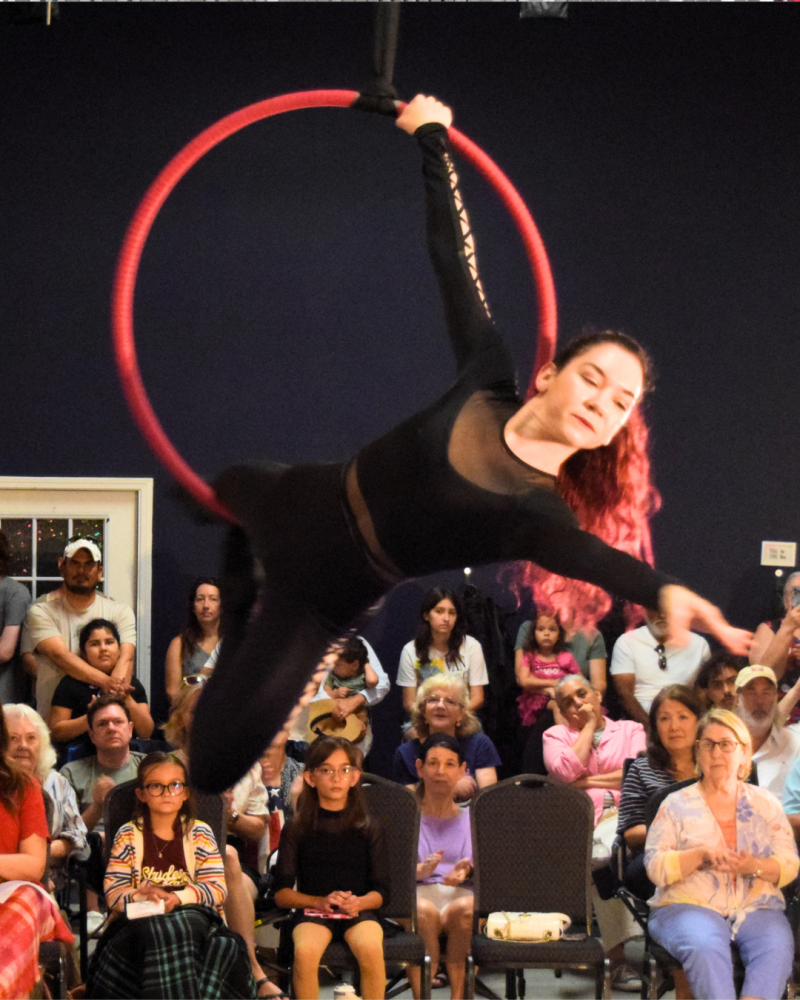
I watched that legacy take a visible shape this past weekend at our Student Showcase, and I haven't stopped thinking about it since.
What struck me wasn't simply that students performed in front of a crowd, although for many of them, that alone took real courage. What struck me was how many of them didn't just get into the air and run through a sequence of moves. They committed to the process behind a piece. They learned choreography and held themselves accountable to it, count by count, transition by transition. They brought their own artistry into the work, the small interpretive choices that turn a skill into a performance: a particular quality of movement through a drop, a facial expression that matched the music, a transition they reworked three or four times until it actually felt like theirs instead of something handed to them. And the room was full of the people who love them most, friends and family who came out to fill the seats and watch all of it unfold.
What that audience witnessed, whether they had language for it or not, was the fruit of exactly the kind of culture I've described above. Nobody got pushed onto that stage before they were ready. Nobody was rushed through a skill just because a showcase date was approaching and a program needed to look impressive for marketing purposes. Instead, what they saw was students who had been given the time, the instruction, and the belief that the process itself was worth honoring, and who had taken that gift and run with it. Persistence and belief are a beautiful combination, and this past weekend, our community didn't just demonstrate that truth. They embodied it, several feet off the ground, in front of everyone who loves them.
That is what I want this studio's legacy to be. Not a list of our highest grossing programs. Not a case study in efficient growth. I want it to be a record of a community that pointed, again and again, to a loving God who never led us astray, and who never once asked us to leave a person behind, or to walk away from a well-prayed-over and genuinely confirmed pursuit, simply because we lacked what was needed to finish it as well as we knew it could be finished. I have not seen that promise broken yet. Not once. I have seen it stretch us, slow us down, and occasionally ask more patience of me than I thought I had. But I have never seen it fail to provide, eventually, exactly what was needed for the next faithful step. Philippians 1:6 has carried me through more uncertain seasons than I can count: being confident of this, that He who began a good work in us will carry it on to completion. I take that as a promise over the continuous work God is doing in our studio.
So, if you're an owner asking how to keep your studio afloat, I won't pretend I have a formula, and I genuinely don't have a list of high-revenue classes to hand you. What I have is this: start with the actual needs in front of you. Take honest stock of what's actually been given to you already. And then ask for direction, even when you can't yet see how it will be funded. The peace that follows that kind of asking has a way of becoming the very culture your studio breathes. Ours has. I hope, in time, yours will too.
Peggy Ployhar, Owner - Eternal Aerial Arts, Kemah, TX
Add comment
Comments