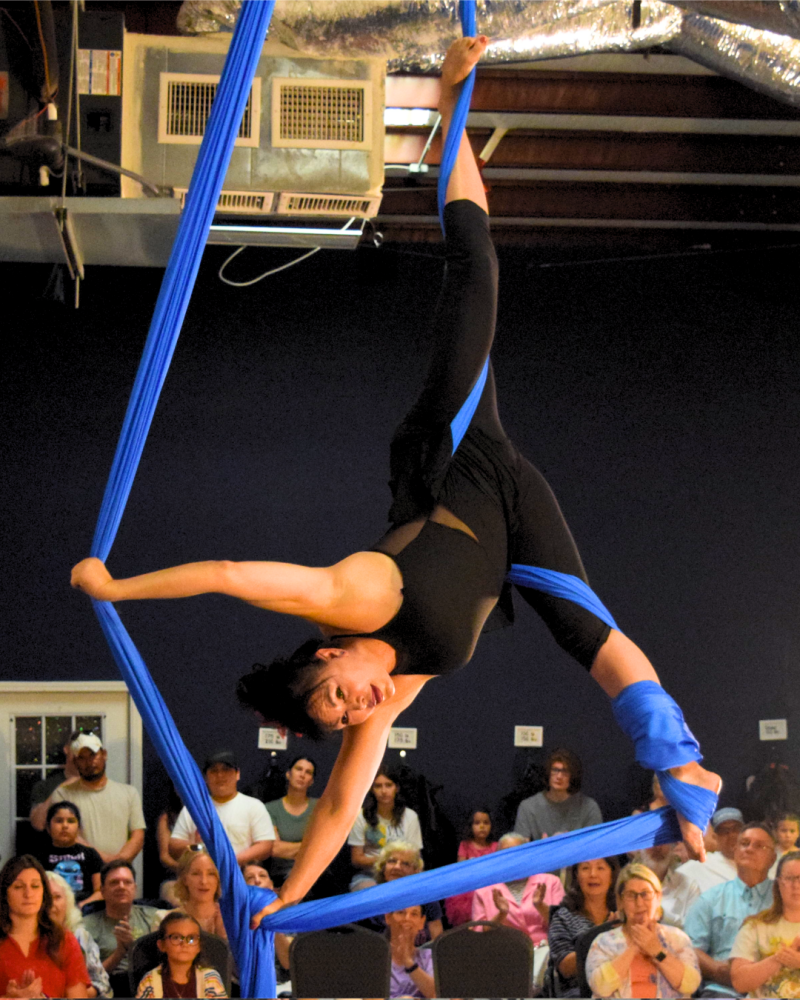
Contentment isn't the opposite of ambition. It's what makes healthy ambition sustainable. It's what allows a student to keep showing up to conditioning class even when it's not glamorous, to perform or compete at a level lower than they would like, to trust that the skills she's learning and working through today are building the very strength she'll need for the skill she's dreaming about tomorrow, to find real delight in where she is instead of only in where she's headed.
I want that sentence to sit with you for a moment, because it's the answer to a conversation I have, in one form or another, almost every season. Sometimes it's an adult student who used to be further along in her aerial progress before life pulled her away for a while. Sometimes it's a parent watching her daughter's friends move up a level and wondering why her own daughter hasn't. The details change, but the heart behind the question is almost always the same: Am I progressing fast enough? Why can't I just move up now? What if I never catch up?
I love these conversations, honestly, even when they're hard. Because underneath the question about class levels and skill requirements, there's almost always a deeper question about worth, about comparison, and about whether it's okay to simply be where you are right now. And I believe with everything in me that the answer isn't found by rushing the timeline. It's found in learning to be content in the timeline you're actually in.
Why Contentment Isn't Passive
I want to be clear about what I'm not saying. Contentment isn't the same as giving up on growth, and it certainly isn't an excuse to stop working hard. A student who is content isn't a student who has quit dreaming. She's a student who has stopped letting the gap between where she is and where she wants to be steal her joy in the meantime.
That's a hard thing to learn, and it's not natural. Scripture tells us that Paul had to learn the secret of being content in every circumstance — whether he had plenty or little, whether things were going his way or not (Philippians 4:11-13). Contentment was a discipline for him, not a personality trait. And what strikes me most is what that passage says comes next: it's through Christ's strength that this kind of contentment becomes possible. Contentment isn't the finish line of the Christian life. It's the doorway into real freedom — including the freedom to grow.
This is exactly why contentment and ambition aren't opposites. A student who has learned to be content isn't a student who stops striving. She's a student who can strive without anxiety, without comparison, and without cutting corners just to get somewhere faster. She's free to actually build, layer by layer, instead of white-knuckling her way toward a level she isn't ready for yet.
Bloom Where You're Planted
There's a passage in Jeremiah I return to again and again, both in my own life and in conversations with students and parents. God's people had been carried into exile — into a place they never chose and didn't want to stay in. Instead of telling them to fight it or simply endure it while waiting for something better, God told them something different: build houses and live in them, plant gardens and eat what they grow, seek the peace and prosperity of the place you've been planted (Jeremiah 29:5-7).
That's not resignation. It's an invitation to actively flourish exactly where you are, instead of merely tolerating it while you wait for the next thing. That posture — grumbling, comparing, striving in ways that press us too quickly — actually works against growth rather than toward it. It's only when we stop fighting the season we're in and start blooming in it that real strength gets built. And that strength is precisely what makes the next level, whenever it comes, sustainable rather than shaky.
This is what conditioning for skills looks like in practice. It's not glamorous. Nobody dreams of ground conditioning the way they dream of a beautiful drop or a clean invert. But it's often the unglamorous, patient work — not another class, not more time in the air, not rushing to the next skill — that actually builds the strength a student needs. I've watched students who committed to conditioning progress further and more safely than students chasing the same goal through sheer repetition. The dream skill is built in the unseen, unglamorous hours. That's contentment and ambition working together, exactly as they're meant to.
Why We Don't Compromise on Progression
Here's where this becomes more than a nice sentiment — it becomes a conviction I hold firmly as a studio owner. Aerial arts is not like most other pursuits. When a student inverts mid-air, wraps into a sequence without slipping, or perfectly controls a drop, her safety depends entirely on whether her body and training have actually caught up to the skill she's attempting. This isn't a place where enthusiasm can substitute for readiness, and it isn't a place where simply showing up, on its own, earns the next level.
We live in an age of participation trophies, where effort and attendance are often treated as equivalent to mastery. I understand the impulse — we want to encourage people. But in aerial, treating attendance as the same as readiness isn't kind; it's dangerous. It isn't wise, and it doesn't serve the student or the studio well in the long run. A student pushed into skills before her strength and technique can support them is a student at real risk of injury, and worse, a student who may never fully trust her own body in the air again.
This is why I've never compromised on progression, even when it costs me a student. There have been families and adult students over the years who wanted to move faster than proper training allows, whose desired timeline outpaced their actual readiness. When that's genuinely what someone is looking for, I've had to be honest and tell them our studio isn't the right fit. I know some of those students found their way to other studios in our area that do teach that way, letting eagerness dictate advancement rather than readiness.
Here's what I've watched happen, more than once: those students often do execute, with shortcuts, the higher-level skills they were looking to master. It looks, for a season, like the shortcuts worked. But given enough time, the gaps show. Skills built without a solid foundation start to wobble. Confidence outpaces competence, and eventually either bodies or skills hit a wall that proper progression would have prevented. They end up capped at a level far below what they could have reached if they'd simply trusted the process — and stayed content within it — from the start. Slow and solid beats fast and shaky every time.
Where Real Joy Actually Lives
So here's what I want every student and parent in our aerial family to hear: true joy isn't found once you finally reach the next level. It's found in choosing to press into where you are right now, trusting that God has you in this season for a reason, and refusing to let comparison to someone else's timeline steal what's meant to be built in you today. When we press into that joy — His joy, right where we currently stand — we stop comparing our chapter three to someone else's chapter ten. We stop striving in ways that rush us past the very foundations we need. We start accepting the process instead of fighting it.
And that's precisely when growth accelerates, because contentment has finally freed us to actually work with our training instead of against our own impatience.
So if you find yourself frustrated this season — with your level, your progress, your timeline — I want to gently invite you into something different than striving against where you are. Keep showing up to conditioning even when it's not glamorous. Keep performing or competing at a level lower than you'd like, for now. Trust that the small, unseen work you're doing today is building the very strength you'll need for the skill you're dreaming about tomorrow. Find real delight in where you are, not only in where you're headed.
That's where real growth happens. Not in skipping ahead, but in fully, joyfully inhabiting the season you're in.
Add comment
Comments