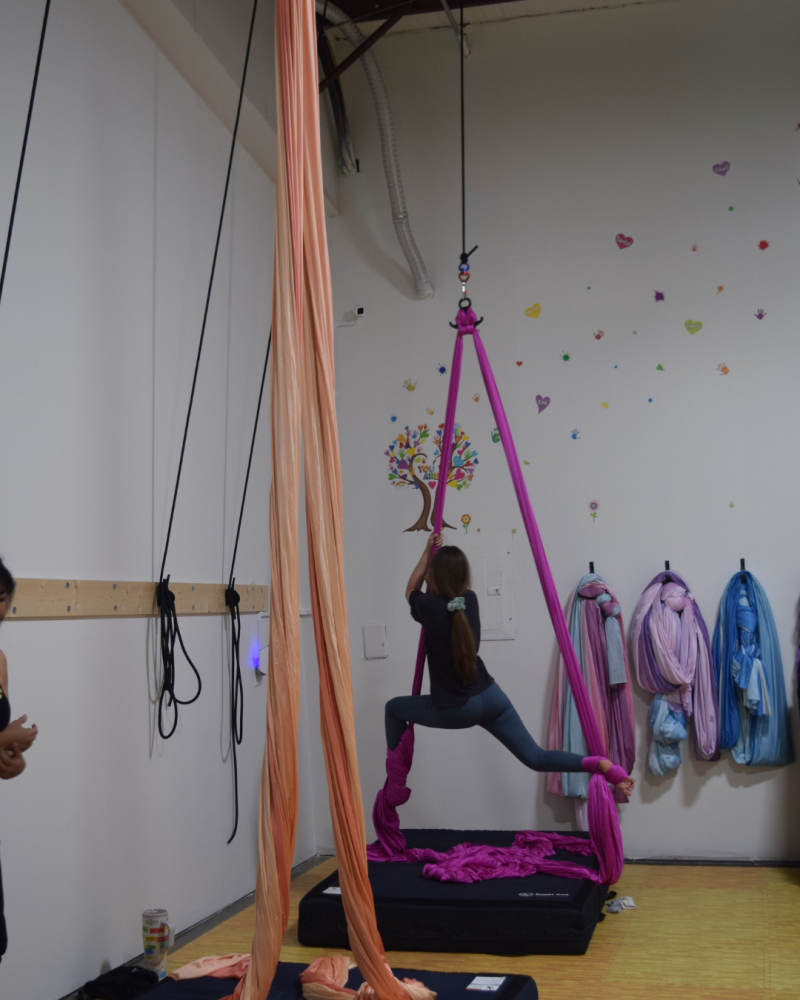
Open gym is one of the most valuable tools in an aerial athlete's training, and one of the most misunderstood. It isn't a class. It isn't a free-for-all. It's dedicated, self-directed practice time in a supervised space — and the athletes who get the most out of it are the ones who walk in with a plan and a healthy respect for the risks involved.
Whether you train with us at Eternal Aerial Arts or you're visiting an open gym somewhere else, the expectations below are industry standard. They exist because aerial is a beautiful sport with very real consequences, and because the studios hosting you carry insurance requirements that shape nearly everything about how the space is run.
Before You Go: Plan Your Session
1. Reserve your space. Don't just show up.
Every studio has a hard limit on how many bodies and how many apparatus can safely occupy the floor at once. When you reserve ahead, the studio can confirm there's an open spot, an available apparatus, and appropriate supervision on the schedule. Showing up unannounced may mean being turned away — not because anyone wants to, but because the mat space simply isn't there.
Looking for our open gym schedule, use this link
2. Know what you're working on before you walk in the door.
Open gym time evaporates when you spend the first twenty minutes deciding what to do. Come in with a plan. A good session usually falls into one of these buckets:
- Skill refinement — a move you learned in class recently that needs repetition to become clean and consistent
- Performance prep — running your piece, smoothing transitions, building the stamina to get through the whole routine
- Conditioning and drills — pull-ups, inverts, climbs, active flexibility, grip strength, core work
Write it down. A simple three-item list on your phone will keep you honest and moving. And be realistic about volume — a focused forty-five minutes on two skills beats a scattered one and a half hours every single time.
3. Warm up and cool down like you would in class.
This is the step people skip most, and it's the one most directly tied to injury. Because no instructor is calling out the warm-up or cool downs, it's on you. Give yourself a genuine ten to fifteen minutes: raise your heart rate, mobilize shoulders and spine, activate your core and grip, and do a few low, easy moves or inverts before anything demanding. Cold shoulders and cold hamstrings are how open gym sessions end early. Repeat at the end with your cool down the last 5 to 10 minutes of open gym time.
4. Dress and prepare appropriately.
Full coverage where the apparatus contacts your skin, no zippers, buckles, or loose clothing that can catch. Hair secured. All jewelry off — rings especially, which are a serious hazard on fabric and bars. Bring water and keep it near you. Come fed and hydrated; low blood sugar shows up as shaky grip and poor judgment.
During Your Session: Train Well and Train Safely
5. Respect the shared space and the people in it.
- Keep your bag, water, and belongings tucked near your station, not sprawled across walkways or mats.
- Be friendly, but read the room. Everyone is there to work. A short hello is welcome; a running conversation that pulls someone out of their focus is not.
- If you train better with music, bring earbuds. Playing music out loud from your phone takes the choice away from everyone else in the room.
- Keep the area under and around your apparatus clear, and stay aware of your mat space and don't do any skills that move outside the zone of your mat.
6. Know your limits and stay inside them.
Train over your mat. Train at the height you regularly work at in class with your instructor. Take breaks before you need them — most aerial injuries happen on the skill you try after you got tired, not the skill you were strong for. Fatigue degrades grip, timing, and decision-making in that order, and all three are load-bearing in this sport.
If a skill felt shaky the last time an instructor watched you do it, open gym is not where you make it braver. It's where you make it cleaner.
7. Be honest about past injuries.
Old shoulder impingements, wrist issues, a knee from a completely unrelated sport, a back that flares up — these follow you onto the apparatus. Aerial loads joints in ways very little else does. Know what your body currently tolerates and train accordingly, and if something has changed since your last class, tell your instructor before you get in the air rather than after.
8. Use the supervising instructor.
There is always an instructor watching over open gym at our studio. Ask them to change out your apparatus if you need a different one. Ask them a question if you're unsure whether you are properly executing the move you are working on. Ask them to take a look if a skill isn't feeling right. That's what they're there for. They aren't teaching a class, so they won't be coaching you through new material — but they are a resource, and you should use them.
9. Have fun, encourage others, and celebrate your progress.
Open gym is where the quiet wins happen. The climb that finally felt easy. The invert you didn't have to think about. The drill you couldn't finish six weeks ago. Notice those. Cheer for the person across the room who just got theirs. The culture of a studio is built in these hours, not in performances.
What Open Gym Is Not For
These aren't suggestions. Every one of them traces back to a real injury that happened to a real athlete somewhere.
1. Don't work skills you haven't been taught in class by a trained instructor.
Open gym is for practicing what you know, not acquiring what you don't. Progressions exist because the strength, body awareness, and understanding of the wrap build in a specific order. Skipping steps is where people get hurt.
2. Don't learn from videos.
Social media is full of aerialists performing skills at a level you can't see from the outside — with conditioning, spotting, and years of preparation edited out. Video of a wrap does not show you how it locks, the failure point, or what happens if your hand slips or grips wrong. The only video you should reference is one you recorded of yourself in class, being taught by your instructor.
3. Don't teach others, and don't ask others to teach you.
Your classmate may perform a skill beautifully and still have no idea how to progress someone else into it, spot it, or recognize when a body isn't ready. Teaching requires training and certification. When someone asks you to show them something, the kind answer is, "Ask the open gym instructor — they can get you there safely."
4. Don't exceed your level.
A healthy fear is an asset in this sport. The athletes who last are the ones who are honest about where they are and what is unsafe and safe based on their current progressions.
5. Don't goof around.
Horseplay on or near apparatus is how someone else gets hurt, not just you. Aerial carries serious risk, and the floor deserves the same seriousness you'd give a gymnastics or climbing gym.
6. Don't change out your apparatus or touch the rigging.
Not the ropes or cleats and not the mats' positioning under a live point. Ask the supervising instructor. Always.
7. Don't train impaired or unwell.
Sick, sleep-deprived, on new medication, or coming off an injury you haven't been cleared from — these are all reasons to condition on the floor instead of getting in the air.
Why the Rules Are This Strict
Studios like ours operate under insurance requirements that dictate who may teach, what training and certification instructors must hold, how skills must be delivered in progression, and how rigging is handled and by whom. These are not arbitrary policies we invented to slow you down. They are the terms under which a studio is permitted to exist, and they are built from the industry's collective experience of what goes wrong when corners get cut.
We are not trying to limit what you can do. We are trying to make sure you're still doing it in ten years — with the same shoulders, the same wrists, and the same joy you walked in with.
Discipline in the small things is what earns the big ones. Plan your session, respect the space, stay inside your boundaries, and let your progress be the steady kind that lasts.
See you at the studio!
Peggy Ployhar, Owner of Etenral Aerial Arts
Add comment
Comments