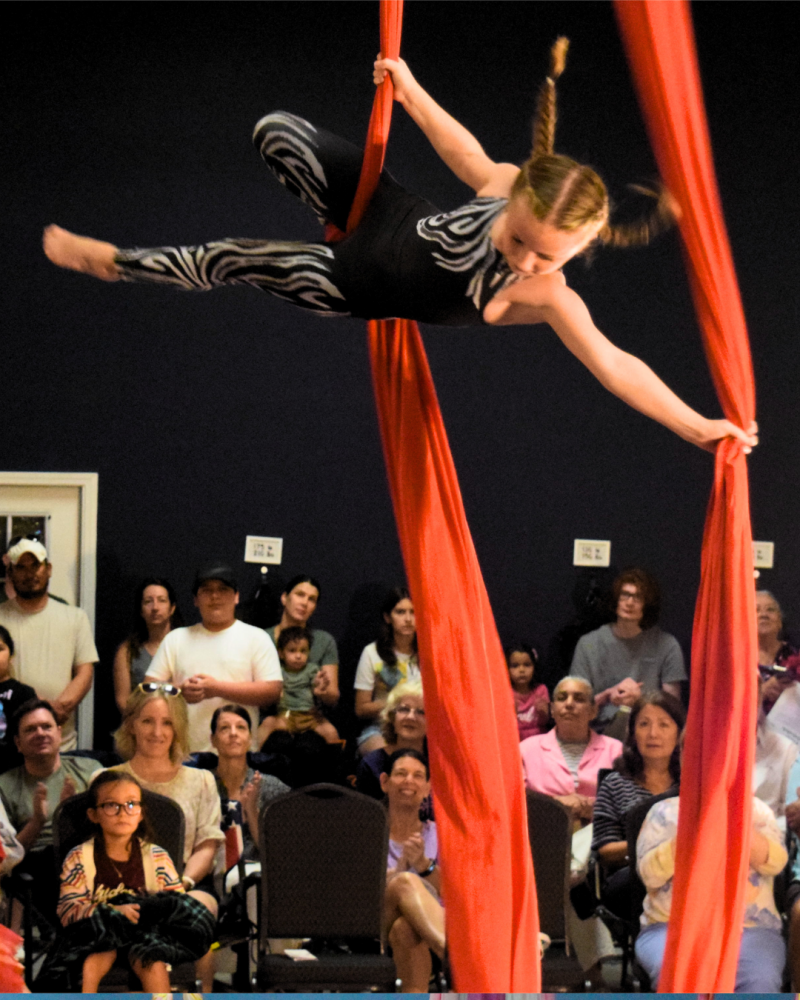
With our Showcase Prep Workshop coming up on Saturday, August 29th (9am–noon), I wanted to take some time this week to talk about something bigger than choreography appointments and costume choices. I want to talk about why we perform at all — and how you can walk into this showcase season with a clear heart and a steady mind, whether this is your first time stepping into the spotlight or your fifth.
If you're a student on the fence about performing, or a parent wondering how to help your aerialist prepare, or even a fellow studio owner or coach looking for a framework to hand your own students — this one's for you.
The Practical Things Worth Thinking Through
Before we get to the heart of it, let's talk logistics, because good preparation actually frees you up to focus on what matters most.
Music. Your music sets the tone before you ever leave the ground. Choose something that fits the story you want to tell — not just a song you like on repeat in the car. Ask yourself: does this song's energy match my skill level and the mood I want to create? Does it have a clear beginning, middle, and end that I can choreograph around?
I have also found that music that works best for aerial performances has multiple tempo changes, dramatic beat drops mixed with slow as well as fast tempos. It is amazing how much the music can work for you or against you when you perform, so choose wisely.
Audience. Every act at our showcases must be family friendly. This isn't a limitation on your artistry — it's an invitation to find creative, thoughtful ways to tell a story that everyone in the room, from grandparents to toddlers, can receive and enjoy.
Costume. All costumes must be modest. Again, think of this not as a box to check but as a design challenge. Modesty and beauty are not opposites. Some of the most striking costumes we've seen on our stage have been the ones that let the choreography — not the fabric — do the talking.Plus, a wardrobe malfunction mid-air is embarrassing for everyone in the room — you and your audience alike. Once you've chosen your costume, do a few dress rehearsals in it to make sure you can execute your moves comfortably and confidently while wearing it.
Character, emotion, and story. This is where your performance starts to come alive. Before you worry about tricks, ask: What am I trying to say? What emotion am I trying to create in the room? Are you telling a story of joy, of struggle and triumph, of playfulness, of wonder? Let that answer shape your transitions, your facial expressions, and even which skills you choose to include.
How you want your audience to feel. This might be the single most important question you ask yourself in the studio this month. Not "how do I want to look" — but "how do I want them to feel" when they watch me. Inspired? Moved? Delighted? Amazed? Let that feeling be your north star in every choreography decision.
Your why. And underneath all of it — why are you performing at all? Hold onto that answer. You're going to need it.
Performing Is a Gift You Give, Not One You Receive
Here's something I want every student and every parent to sit with this season: performing is rewarding, but it is not for you.
Yes, preparing for a showcase will make you press in. It will make you work harder in the weeks leading up to it. It will sharpen skills that have been sitting comfortable for too long. That's a real and good gift the process gives you. But the performance itself — the moment you're up in the air in front of an audience — that moment belongs to the people watching, not to you.
This distinction matters more than it might seem. If you walk on stage looking for the performance to fill you up, to prove something to yourself, to give you the validation or confidence you've been missing — it will let you down. Every time. The spotlight is short-lived. The applause fades before you've even made the descent off your apparatus. If your cup depends on that spotlight, you will always be chasing a feeling that empties out faster than you can refill it.
But if you walk on stage understanding that this moment is a gift you are giving to the people in those seats — to share the joy of flight with people who may never get to experience it themselves, to tell a story that moves someone, to be a light for a younger student sitting in the audience who is exactly where you used to be — then the performance becomes something durable. Something that matters beyond the three to five minutes you're in the air.
Fear Is Not a Reason to Back Out
If you're nervous about performing, I want you to hear this clearly: fear is not a good enough reason to say no.
Nerves before a showcase are normal. They don't mean you're not ready, and they certainly don't mean you shouldn't do it. Some of the most meaningful growth in this sport happens in the weeks between "I signed up" and "I did it anyway, shaking hands and all." Don't let fear make the decision for you.
At the same time — and this is the other side of that same coin — don't perform only because you're chasing the rush of getting through it. The goal isn't to conquer fear so you can feel the high of the spotlight. The goal is to recognize that this is one part — one small, short-lived part — of a much longer training journey and a much bigger set of aerial goals. Showcase is a checkpoint, not the destination.
What Performing Is Actually For
So if performing isn't about proving yourself, and it isn't about the spotlight either — what is it for?
- To experience the joy of performing, and to let that joy be genuine, not manufactured.
- To share that joy with your audience — many of whom will never get to fly themselves, and who need someone to show them what it looks like.
- To use your skills to elevate a story or a message bigger than yourself.
- To bring others into your performance — to make them feel something alongside you, not just watch you from a distance.
- To inspire the students who are where you used to be — the beginner in the audience working on their first climb, the nervous kid deciding whether aerial is "for them." You have no idea who is watching you and deciding, right then, that they can do hard things too.
That's the why worth carrying into your prep. Not "will I look good," not "will I get through it without falling," but "who will this reach, and what will they carry with them after the lights go down?"
As You Head Into the Showcase Prep Workshop
When you come to the workshop on August 29th, come with your questions about music and choreography, absolutely — that's exactly what it's for. But come with these bigger questions answered too:
- What story or emotion am I telling?
- How do I want my audience to feel?
- What is my why?
Answer those first, and the music, the choreography, the costume — all of it — will start to fall into place around a performance that means something. Not just to you, but to everyone watching.
We can't wait to see what you bring to the stage this season. Whether you've performed a dozen times or you're still deciding if this is the year you finally say yes — know that your "why" doesn't have to be perfect or fully figured out yet. It just has to be honest, and it just has to be yours.
"Let your light shine before others, that they may see your good deeds and glorify your Father in heaven." — Matthew 5:16
Peggy Ployhar, Owner, Eternal Aerial Arts
Add comment
Comments