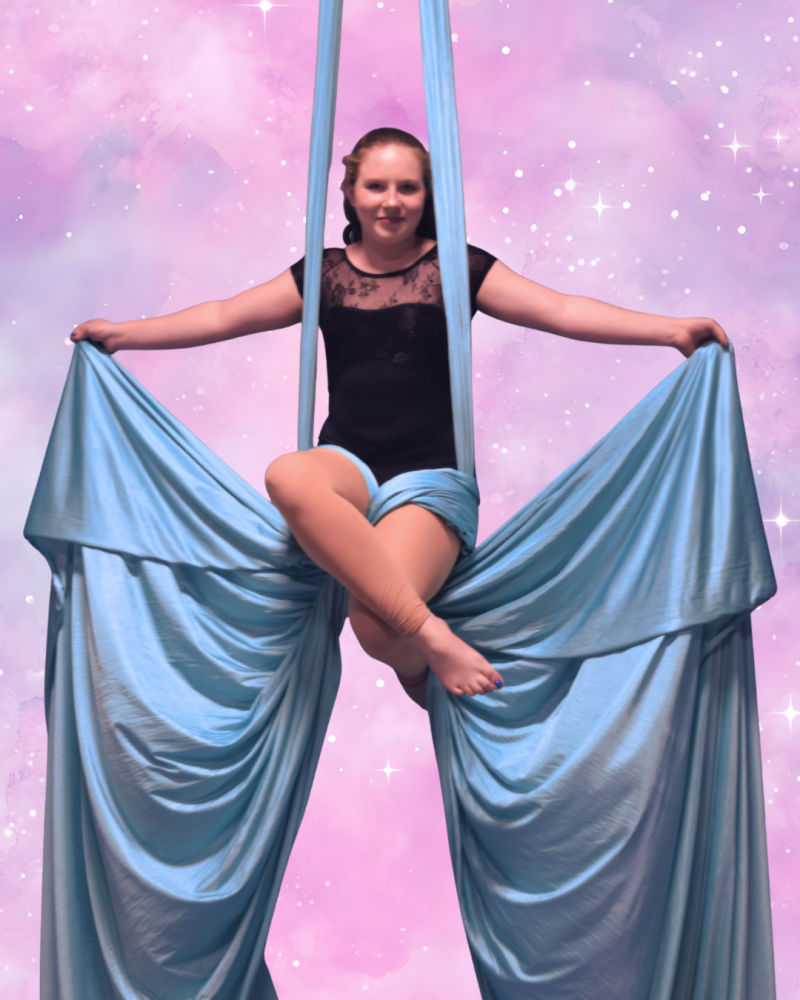
Every person who walks through the doors of an aerial arts studio brings something invisible with them: their reason. Their why. And while the apparatus, the music, and the chalk or grip spray on their hands may all look the same from the outside, what is driving each student to show up, grip the silk, and try again is often something deeply personal — and beautifully different.
At Eternal Aerial Arts, we have come to believe that knowing your why is one of the most powerful things you can do for your training. Not just because it helps you choose the right class or apparatus, but because when your training aligns with the reason you came in the first place, you are far more likely to keep coming back — and to grow in ways that actually matter to you. Research published in the American Psychologist by psychologists Ryan and Deci confirms what good teachers have always known: people who participate in an activity for intrinsic, personally meaningful reasons are significantly more likely to stick with it long-term than those motivated purely by external goals. In other words, knowing your why isn't soft advice. It's the science of sustainability.
So what brings people to aerial? In our experience, it tends to fall into four distinct categories — and every single one of them is welcome here.
The Fun Workout: "I Just Want to Move and Enjoy It"
Some people come to aerial because they want a workout that doesn't feel like a workout. And here is a secret: aerial is spectacularly good at that. There is something about gripping the silk or spinning through a lyra that so fully occupies your brain — figuring out the wrap, the timing, the next step — that you often don't realize how hard you are working until you notice you are thirsty, or sweaty, or your grip is starting to give out. The movement snuck up on you. That is exactly the point.
Research published in the Journal of Sport and Exercise Psychology found that people motivated primarily by enjoyment and personal challenge are more likely to stick with exercise long-term compared to those driven by external factors.
Aerial, perhaps more than almost any other fitness modality, taps directly into this. It is engaging, ever-changing, and genuinely playful in a way that most gym equipment simply is not.
For students who come to us with this why, our encouragement is simple: try several classes, explore different apparatus, and pay attention to what feels like play rather than work. That answer is different for everyone. Some people find their joy on the silks. Others light up on the lyra or hammock. Once you find it, come back to it consistently — because the students who have the most fun also tend to improve the most, often without even realizing they are leveling up their fitness and skills at the same time. Our teachers are here to cheer you on exactly where you are, and also to safely and sometimes surprisingly nudge you to the next level when you are ready.
→ Explore our class schedule and find your fit:
The Community Seeker: "I Need to Find My People"
For others, the pull toward aerial is less about the apparatus itself and more about the people around it. They are looking for a place to belong — a group of humans who show up consistently, struggle together, cheer each other on, and feel like family over time. They want to find their people.
Here is the wonderful thing: aerial class almost automatically delivers this. There is something uniquely bonding about standing in a group, all of you staring up at the same piece of equipment, all of you slightly confused, slightly terrified, and then one by one figuring it out together. The shared challenge creates connection in a way that solitary exercise simply cannot replicate. Social identity researchers have found that true exercise groups promote more enjoyable and pleasurable physical activity experiences because they satisfy core psychological needs, specifically the need for belonging and meaning. And a systematic review on community-based exercise found that social connectedness was a key determinant of long-term adherence, with participants describing their exercise group as their "exercise family."
In our experience, aerial tends to attract a particular kind of person: creative, a little unconventional, not necessarily someone who thrives in a standard gym setting. If that sounds like you, you are going to feel very at home here.
For students with this why, we encourage you to do two things: first, find the apparatus that feels right to your body. Second — and just as importantly — find the instructor and the class group whose energy fits you. We are all creatures of habit, and the classes we attend at the same time each week become anchors in our lives. When you find the right class at the right time with the right community around you, showing up stops feeling like an obligation and starts feeling like the best part of your week.
→ Check out our class offerings and come try one:
The Competitor: "I Want to Train, Set Goals, and Win"
Some students thrive on the structure of measurable progress, concrete deadlines, and coaching that pushes them toward excellence. They do not just want to learn the next skill — they want to nail it at a level of precision that can be evaluated, compared, and rewarded. Competition is not just fun for these students; it is fuel.
Research suggests that extrinsic motivation — like competing for awards or recognition — can be highly effective for initiating new challenges and driving performance in the short term, and for competitors this energy is real and powerful. The key is pairing that external drive with genuine skill development so that the love of the craft grows alongside the hunger for results.
For students who identify with this why, we encourage starting with seasonal competition training — dedicating a focused period of time to preparing a piece for competition when you can give it your full attention and effort. This concentrated approach tends to produce the best results and the most satisfying experience. For those who find they love competition and want it to be a consistent rhythm in their training, our elite competition team trains on a regular weekly schedule, building the kind of technical depth and performance consistency that competition demands. This is not a drop-in-when-you-can situation — it is a commitment, and for the right student, it is an incredibly rewarding one.
→ Learn more about competition training opportunities: Explore options on our teams page
The Performer: "I Want to Move an Audience"
And then there are the ones who came to aerial because they heard the music, they imagined the silk, and they saw themselves on a stage. They love the crowd. They feed off an audience. They want to bring joy, wonder, and maybe even tears to the people watching — and they know, in some deep place inside themselves, that this is what they were made to do.
For these students, every skill they learn is really just another brushstroke. They are painting something. Training toward a showcase or performance is not just motivating for them — it is the whole point.
For students in this category, we actively encourage signing up to train for our student showcases. For our younger students whose parents sense this fire in them, please tell us. Let your child's teacher know that performance is part of their why. That knowledge changes how we challenge these students — we start having them connect learned skills in class so when they eventually start working on their choregraphed piece, they are not just learning moves, they are conditioned to begin building their performance. And it also means that when we look around our classes each year to identify students ready to be invited onto our performance team, we will already know who to watch.
→ Summer Showcase training is now open: Learn more about how to start showcase training
Your Why Can Change — And That Is a Beautiful Thing
Here is something worth saying clearly: your why does not have to stay the same. In fact, one of the most exciting things about aerial is how it can slowly reveal things about yourself you did not know were there.
You might come in for the workout and discover you have a fierce competitive streak you never had an outlet for. You might come in for community and find yourself dreaming about a stage. You might come in to compete and realize that what truly fills you up is not the medal, but the moment the music starts and the audience holds its breath.
At Eternal Aerial Arts, we do not push students into boxes or pathways they never signed up for. We do not require our regular students to perform in end-of-season showcases. Instead, at the end of each kids' session, students have the option to show off their new skills to their parents for the last five minutes of class — a low-stakes, joyful moment that celebrates progress without pressure. For those ready for more, we point them toward competition or showcase training. The decision is always theirs.
We are not here to ask something of you that you never signed up for. We are here to meet you where you are, help you discover where you want to go, and walk alongside you as you get there.
A Note from Peggy — My Own Why
I came to aerial for a fun workout. That was it. I had no grand vision, no performance dreams, nothing beyond wanting to do something that felt more like play than exercise.
But aerial has a way of showing you things about yourself. Over time, I started to realize that what truly lit me up was not the workout — it was the performance. The audience. The moment a piece of music and a moment in the air and a room full of people all come together into something that moves someone.
Looking back, it was always there. Classical ballet as a child. Years of cheerleading. Two decades of public speaking. Eight years of podcasting and video work. Aerial performing was not a departure from who I was — it was the natural next step.
I have tried competing too. I even did well — placed second against competitors decades younger than me, which I was genuinely proud of. But I found that competition added a kind of stress to my training that did not serve me. I would rather spend that energy training to inspire an audience than training to win a medal.
Neither path is better. They are just different — and that is exactly why our studio exists in both spaces. Because your why is yours. And whatever it is, we want to help you pursue it with everything you have got.
For Studio Owners: Programming to the Why
If you run a studio or are building one, this framework is worth taking seriously. One of the most common reasons students leave a studio is not because the instruction is poor — it is because their training stops feeling personally meaningful. They showed up for one reason and the studio kept pushing them toward something else.
A few practical ideas for aligning your programming with your students' why:
Start with a simple intake conversation. When a new student registers, ask them what brought them to aerial and what they are hoping to get out of it. You do not need a formal survey — a casual, genuine conversation is often enough. What you learn will shape how you place them, how you communicate with them, and how you retain them long-term.
Train your teachers to recognize the different whys. A competitor and a community seeker need very different things from the same class, and a skilled teacher can honor both simultaneously. This is a coaching skill worth developing intentionally.
Build clear pathways, not pressure funnels. Students with a performance why should have a clear, inviting road toward showcases. Students with a competition why should know exactly how to step into training. But neither should ever feel pressured into the other's path. Autonomy is one of the three core psychological needs identified in Self-Determination Theory — and research shows that when it is threatened, dropout follows.
Finally, celebrate progress in multiple ways. Not every student wants a trophy. Some want a photo of their first inversion. Some want a moment to show their parents. Some want a coach to quietly say "that was really good today." Know your students well enough to know which kind of celebration fuels them — and give it to them freely.
The students who stay the longest are the ones who feel seen, heard, and honored for the reason they walked in the door. Build your studio around that, and retention will take care of itself.
Peggy Ployhar Owner, Eternal Aerial Arts
Add comment
Comments