As aerial instructors, we all feel the pull. A student is struggling to invert. They're frustrated, maybe even close to tears. We watch them try again and again, their grip slipping, their core shaking. The solution seems obvious: tie a knot in the fabric. Give them that boost. Let them experience what it feels like to be upside down, wrapped in the silks, finally succeeding.
It's one of the most tempting decisions we face in teaching aerial arts. And it's one of the most important ones to resist.
The Safety Reality of Aerial Arts
Before we dive into the specifics of knot usage, let's ground ourselves in the data. Research on recreational aerial arts students found an injury rate of 13.70 injuries per 1,000 class hours, with 4.13 requiring medical attention per 1,000 hours. While these numbers might seem manageable compared to other sports, they tell us something crucial: aerial arts carries real risk, and how we teach directly impacts student safety.
The most concerning finding? When we look at where injuries happen, height is a critical factor. Falls from greater heights naturally result in more severe injuries, regardless of crash mat thickness. As one experienced aerialist who documented her injury history noted, even with proper mats, falls can cause serious damage—she broke her tailbone in a fall that required her to use a supportive cushion for five years afterward.
This is where the knot conversation becomes essential. Every time we give a student a knot, we're potentially giving them access to height their body isn't ready to control.
The Illusion of Progress
Here's what I've observed after years of teaching aerial arts, combined with nearly two decades of homeschooling unique learners and years as a head cheerleading coach: a knot creates the illusion of achievement without building the foundation necessary for true mastery.
When a student uses a knot to get into an inverted position, they're bypassing the most critical part of aerial training: developing the grip strength, core control, and body awareness required to safely move in the silks. They might feel the excitement of being upside down, but they haven't earned the neuromuscular pathways that tell their body how to hold on, how to control their descent, or when they're about to slip.
I've watched countless videos of kids as well as adults slipping out of knots—sometimes flying out during knot drops—precisely because they lack the body control that comes from working through the struggle of inverting without support. The knot gave them access to a position their body wasn't prepared to maintain.
When Knots Work Against Skill Development
Let's talk about what happens neurologically and physically when students rely on knots too early or too frequently.
The Grip Strength Gap
Research on aerial arts injuries consistently identifies the shoulder and upper extremities as primary injury sites, with 34 categorical upper limb complaints noted in one study. Why? Because aerial arts demand exceptional pulling strength and grip endurance. When students use a knot as a regular training tool, they're not developing the finger, wrist, and forearm strength essential for safely controlling their body weight on vertical fabric.
The silks don't care about your intentions—they only respond to physics. Without adequate grip strength, students will slip. With a knot providing support, students often climb higher than they should, putting themselves at greater risk when that inevitable slip occurs.
The Core Strength Deficit
Inverting from the ground without any support is hard. It should be hard. That difficulty is your body building the core strength, hip flexor power, and shoulder stability needed for aerial work. Every failed attempt where a student gets partway up and has to come back down is actually success—they're building strength, learning body positioning, and developing the mental resilience aerial arts demands.
When we introduce a knot too soon, we rob students of this essential development phase. They learn to depend on external support rather than building internal strength.
The Height-Skill Mismatch
Here's a scenario I've seen play out too many times: An instructor ties a knot "just this once" to let a struggling student experience success. The student loves it. They beg to use the knot again. Before long, they're climbing up into it, experimenting with different positions, and getting significantly higher off the ground than their actual skill level warrants.
Now that instructor has a problem. The student has discovered they can access exciting positions and impressive heights with the knot. Taking it away feels like punishment. But leaving it in place means the student continues training in a danger zone where their grip strength, body control, and safety awareness haven't caught up to the heights they're reaching.
The Temptation Instructors Face
I want to be clear about something: I completely understand why instructors reach for the knot solution. We want our students to succeed. We want them to feel accomplished. We don't want them to become discouraged and quit. When you're watching a student struggle week after week, adding that knot feels like compassion, like good teaching.
But here's what I've learned through teaching students with diverse needs, abilities, and learning timelines: the greatest gift we can give our students is our belief in their ability to achieve difficult things through persistent effort. Not someday, not with modifications—right now, exactly as they are, through proper progression and patience.
Safer, More Effective Alternatives
So what do we do instead? How do we support students who aren't ready to invert without creating dangerous dependencies?
Mat-Based Training
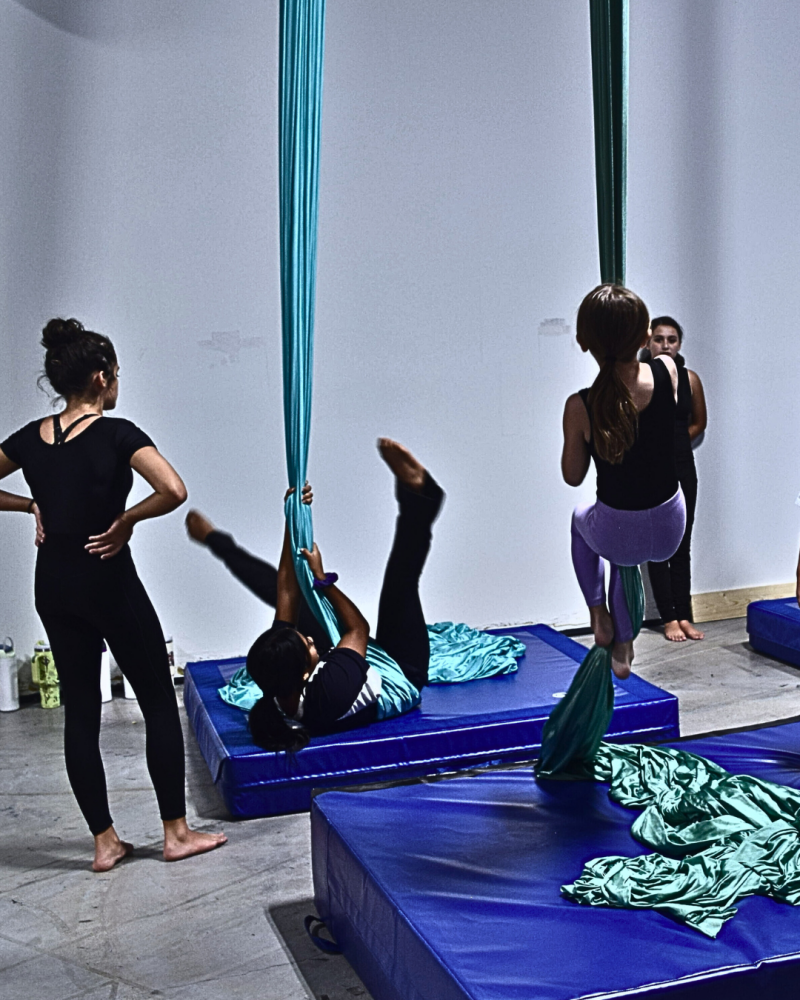
This is where the real magic happens. When students work sitting on the mat, they can focus entirely on the mechanics of inverting—the leg positioning, the wrap technique, the hand placement—without the added challenge of supporting their full body weight or the fear of falling.
I have students roll back on the mat, pull up into inverted positions, and work through leg wraps while lying down. This approach builds the muscle memory and understanding of body mechanics they need, all while keeping them completely safe.
One of my favorite progressions: having students sit on the mat, tuck their body into a ball, put the silks on their side of their body, and then roll back while working to pull themselves just a bit off the mat to gain some air time. They can practice the motion repeatedly, build strength gradually, and when they finally take it standing—no knot needed—they know exactly what to do.
The Modified Double-X Hold
For students who need something more than mat work but aren't ready for independent inverting, I teach a double-X modification. Students put the fabric in a double-X on their back, then hold the tails against the poles with their hands. This creates support only as long as they maintain their grip—it can't be climbed into like a traditional knot.
The brilliance of this approach is that it requires active engagement. The moment they let go, the support slides. There's no risk of them climbing up and attempting to drop from it. It provides just enough assistance for students who need it while keeping them grounded and focused on building their grip strength.
The Progressive Attempt Method
Here's my rule of thumb with students at the Red and Yellow levels (Beginner and Advanced Beginner 1) who are still working on their first unassisted invert: Try it without support first. Every single time.
Each inversion attempt—whether it's during conditioning, a warm-up obstacle course, or skill progressions—students try it on their own first. If they can't complete the invert, then and only then can they add the double-X support.
The results of this approach have been remarkable. Some students achieve independent inversions within weeks. Others take multiple sessions. But here's what's universal: when you communicate that you believe in their ability to reach this goal, and you refuse to give up on that belief, students rise to meet it.
When Knots ARE Appropriate
I want to be balanced here. There are times when knot usage makes sense:
Introduction Classes: For one-time aerial experiences where students won't be building on skills progressively, a low knot in the final 15 minutes—with one-on-one spotting—can safely introduce the sensation of being inverted. Students do a simple straddle where their legs hold them in position. This creates a positive experience without establishing bad training habits and helps the finish the hour strong when their hands and feet are exhausted from gripping and footlocks.
Intermediate and Advanced Students: Once students have superior body control and can confidently invert without support, knots become valuable training tools. I use them for:
- Providing kinesthetic feedback for complex movement sequences
- Targeted conditioning exercises that isolate specific muscle groups
- Advanced combinations where support allows students to focus on technique rather than basic position maintenance
(When I tell my advanced students to tie off a knot, they typically groan—because they know the challenging conditioning exercises that are coming their way!)
Senior Adult Conditioning Classes: In my aerial conditioning classes for students over 60, I do use knots for about 30 minutes of the hour-long class. These students aren't building toward performance skills; they're focused on strength, flexibility, and safe movement. The knot provides appropriate support for this demographic and training goal.
The Long-Term Payoff
Research on aerial arts consistently emphasizes the importance of progressive skill building. One study noted that proper progression means "building off of foundational skills to achieve or pursue an advanced state," warning that trying advanced moves before mastering basics leads to injury and poor technique.
When we resist the temptation to introduce knots prematurely, we're doing our students a profound service:
- We're building real strength: The grinding, frustrating work of learning to invert without support creates genuine physical capability that transfers to every aerial skill they'll ever learn.
- We're developing mental resilience: Students who work through weeks of failed inversion attempts learn that their bodies are capable of things that initially seem impossible. This mindset serves them in aerial arts and far beyond.
- We're keeping them safer: By keeping training grounded until students have the strength and control for height, we dramatically reduce injury risk. Students who can't invert on their own near the ground have no business being 5 feet up in a knot.
- We're teaching patience and process: In our instant-gratification culture, aerial arts offers a powerful counternarrative. Real skill takes time. Growth isn't linear. Struggle isn't failure—it's the pathway to mastery.
A Final Word to Instructors and Students
To my fellow instructors: I know the pressure you feel. I know that other studios you may have trained at might offer knots freely, and you might worry about losing students to studios with "easier" approaches. But I encourage you to view your role differently. You're not just teaching aerial skills; you're teaching students what they're capable of when they commit to a process, trust their instructors, and believe in their own potential for growth.
To students and parents: If your instructor is making you work for your inversions, if they're keeping you on or near the mat when you'd rather be climbing high, if they're refusing to give you that knot even when you're frustrated—that instructor is giving you a gift. They're investing in your long-term success and safety, even when it would be easier to give you the quick win.
The aerial arts community is still developing standardized safety guidelines, but one principle remains clear: height without control is dangerous. Skill without strength is temporary. And shortcuts in foundational training create gaps that become problems later.
The next time you're tempted to tie that knot, ask yourself: Am I doing this to serve my student's long-term growth, or am I doing this to relieve my discomfort with their struggle?
The answer to that question might just change how you teach—and how your students soar.
Add comment
Comments