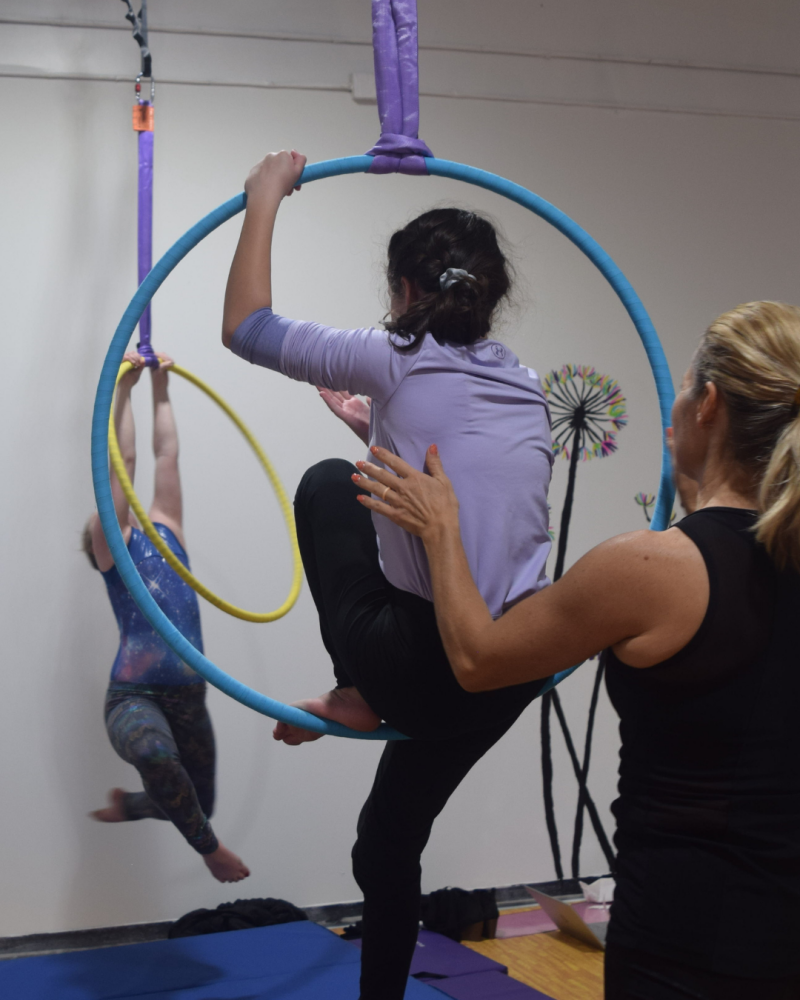
Introduction: Understanding the Kinesthetic Learner
Welcome to the final article in my teaching series on different learning styles in aerial arts! We've explored verbal learners who need detailed linguistic instruction and visual learners who need to see demonstrations. Today, we're diving into kinesthetic learners—students who learn best through physical movement, hands-on experience, and actually doing the skill.
Full disclosure: I am a kinesthetic learner. And I can tell you from years of personal experience that my learning process looks different from many of my peers. When I'm learning a new aerial skill, I've found that I learn best through a specific pattern: I try something first and fail, then I watch and hear how to do the move, and then I try again with that new information. That initial attempt—even when it's wrong—gives my body a reference point. It helps me understand what I'm trying to achieve and what adjustments I need to make.
This "try-fail-learn-try again" cycle is actually supported by research. Studies show that for individuals without memory deficits, trial and error learning results in better retention of skills than errorless learning methods. When we make mistakes and then correct them, we create stronger neural pathways than when we simply follow perfect instructions from the start.
But here's the critical truth we've emphasized throughout this series: no one learns exclusively through one modality. Research consistently shows that learning style is a state-like learning preference that changes depending on the learning environment or context. Even the strongest kinesthetic learners still benefit from verbal explanation and visual demonstration. That's why effective teaching always integrates multiple approaches—verbal cues, visual demonstration, and kinesthetic practice—regardless of which learning style we're focusing on.
In aerial arts, kinesthetic learning is both natural and essential. Aerial is an inherently physical discipline—you literally cannot learn it without moving your body. But there's a difference between passively going through motions and actively engaging in kinesthetic learning. Understanding how kinesthetic learners process information helps us create teaching environments where they don't just move—they learn.
The Science Behind Kinesthetic Learning
Kinesthetic learning is defined as learning that involves physical activity, where students prefer whole-body movement to process new and difficult information. These learners excel in concrete learning such as hands-on training, physical practice, and experiential activities.
How Kinesthetic Learning Works in the Brain
When you engage in physical movement during learning, multiple brain regions activate simultaneously. The cerebellum tracks sensory prediction errors by first estimating the feedback it should receive from a movement, then evaluating the actual feedback. This difference between expected and actual outcomes drives motor learning.
For example, when you attempt a roll on lyra for the first time, your brain expects your body to rotate smoothly. When it doesn't—maybe you don't get enough momentum or your hand placement is off—your cerebellum instantly computes that difference and adjusts the neural commands for your next attempt. This is why practice with variation improves success: repeating a motor skill over and over in slightly different environments and conditions allows the brain to refine its predictions and corrections.
Muscle Memory and Procedural Learning
Muscle memory is a type of procedural memory that involves the ability to repeat a physical task without conscious thought, developed through repeated practice. Kinesthetic learning helps improve muscle memory by engaging the learner's body in the learning process, often involving the whole body to perform physical tasks, which makes the movement more natural and automatic.
This is why kinesthetic learners often retain aerial skills exceptionally well once they've mastered them. The physical repetition creates deep neural pathways that persist over time. A kinesthetic learner who masters a skill through hands-on practice may take longer initially, but often maintains that skill better than someone who learned it primarily through observation or verbal instruction.
The Power of Trial and Error
Here's where my personal experience aligns with the research: evidence suggests that trial and error learning results in better retention of skills than errorless learning for individuals without memory deficits. Moreover, carry-over was significantly better when trial and error learning was used for certain motor tasks.
What does this mean for aerial instruction? Kinesthetic learners don't just need permission to try and fail—they often learn better through that process. The mistake creates a sensory experience that becomes a reference point. When they then receive instruction and try again, they can feel the difference between their first attempt and the corrected version, making the learning more concrete and memorable.
Motor Skills, Coordination, and Spatial Awareness
Research indicates that students who learn through movement often develop strong motor skills, hand-eye coordination, and spatial awareness. Kinesthetic learners typically have excellent proprioception—their awareness or sense of their body in space—which is also known as kinesthesia.
In aerial arts, this proprioceptive awareness is crucial. Kinesthetic learners often have a natural advantage in understanding where their body is relative to the apparatus, how much force to apply, and how movements or wraps should feel, even when they can't see themselves in a mirror.
Identifying Kinesthetic Learners in Your Class
While we teach using multiple modalities for all students, recognizing kinesthetic learners helps us provide the right support and create realistic expectations. Kinesthetic learners often:
- Need to touch, manipulate, or physically interact with the apparatus immediately
- Fidget or move constantly when required to sit still during explanations
- Ask "Can I just try it?" before watching a full demonstration
- Remember skills better when they've physically attempted them, even incorrectly
- Use gestures extensively when describing movements
- Prefer to "figure it out" through trial rather than follow step-by-step instructions
- Excel once they've developed the physical feel for a skill
- Learn better when allowed to move during instruction (standing, pacing, practicing motions)
- Often say things like "I need to feel it" or "I just have to try it to understand"
These students aren't being difficult or impatient—they're processing information through their primary learning channel: physical experience.
The Try-Fail-Learn-Try Cycle: Embracing Productive Failure
As a kinesthetic learner myself, I've discovered that my most effective learning happens in this specific sequence:
1. Initial Attempt (The Try): I attempt the skill with minimal instruction, often just knowing the basic goal. This is why I often try and teach new skills while laying on the floor or very low to the ground. 2. Productive Failure (The Fail): I don't execute it correctly, but I gain physical information about what doesn't work 3. Instruction and Observation (The Learn): I watch/give a demonstration and hear/say verbal cues, which now have context because these aids increase understanding 4. Informed Attempt (The Try Again): I encourage perserverence and multiple attempts with both the physical reference from initial tries and the new information, allowing feel to correct the learning
This isn't just my quirk—it's how many kinesthetic learners process motor skills and how I have learned to incorporate for this need in the classroom.
Why This Works: The Neuroscience
Learning a new sport skill involves trial and error for the brain. The cerebellum manages to dynamically track the difference between what the brain expects to take place when sensory information comes in and what is actually happening. With each attempt, your brain makes slight adjustments among its network of neurons so that the next attempt is more successful.
This system of slight corrections is also useful when transferring skills between similar movements. You don't have to relearn from scratch—you just need to tweak the muscle commands to the new desired result.
Teaching Framework: Kinesthetic Instruction for Aerial Skills
Here's how to structure your teaching to support kinesthetic learners while maintaining the multi-modal approach that benefits all students.
Step 1: Set Safe Boundaries, Then Allow Exploration
What to do: Before students attempt the skill, establish clear safety parameters.
Why it works: This gives kinesthetic learners permission to explore physically while maintaining safety. They can engage their trial-and-error learning process within a structured framework.
Personal note: This is exactly how I learn best. Give me the safety parameters and the goal, let me try it and feel what doesn't work, and then I'm primed to understand your instruction because I have physical context for it.
Step 2: Allow the First Attempt (Even If It's Wrong)
What to do: Resist the urge to correct immediately. Watch the student's first 1-3 attempts, taking mental notes of what they're doing. Let them feel the movement, even if it's incorrect.
Why it works: That first attempt gives kinesthetic learners crucial information: what muscles they're engaging, where their weight is, what feels unstable, where they're confused. This sensory data becomes the foundation for understanding your corrections.
Safety consideration: Obviously, if they're doing something dangerous, intervene immediately. But if they're safe but inefficient, let them explore.
Step 3: Debrief the Experience
What to do: Ask: "What did you notice? What felt difficult? Where did you get stuck?" Let the student verbally process their physical experience.
Why it works: This metacognitive step connects their physical sensation to conscious understanding. It also tells you exactly what they need help with, rather than you assuming.
Step 4: Demonstrate While They Physically Mirror
What to do: Perform a slow-motion demonstration while the student mirrors your movements on the ground or very low to the ground. They're not doing the full skill yet—they're moving through the sequence while watching you.
Why it works: This combines visual demonstration with kinesthetic input. The student builds muscle memory of the sequence before adding the complexity of height or full apparatus engagement.
Step 5: Hands-On Adjustment During Practice
What to do: As the student practices, provide physical guidance: gentle pressure where they should engage, repositioning their grip, spotting, touch particular limbs that need to move, and/or guiding limbs or the whole body through the motion.
Why it works: Kinesthetic learners respond powerfully to tactile feedback. Feeling the correct position or muscle engagement often communicates more than a verbal description.
Important: Always maintain appropriate professional boundaries and get explicit consent before touching students.
Step 6: Varied Practice with Immediate Feedback
What to do: Have the student attempt the skill multiple times with slight variations: different heights, different speeds, with and without a spot, focusing on different elements each time.
Why it works: Research shows that random practice (practicing different subtasks across consecutive attempts) leads to better retention than blocked practice, and minimizing trial-to-trial repetition enhances learning. Variation forces the brain to engage more deeply with the task.
Example: "Try one focusing only on your hand grip... now try one focusing on core engagement... now try one at a faster pace... now slow it way down..."
Step 7: Self-Assessment and Body Awareness
What to do: After successful attempts, ask: "What did that feel like? What was different from your first try? What do you need to remember about how that felt?"
Why it works: This helps kinesthetic learners develop conscious awareness of their proprioception. They're learning to identify and remember the feeling of correct execution.
Example: Student: "It felt like my abs were pulling really hard and my hips kind of... floated up?" Instructor: "Perfect! Lock in that sensation. That's what you're looking for every time."
The Power of Movement Breaks and Active Instruction
Studies show that children who engage in regular physical activity have better executive functions like impulse control and planning skills than those who don't, and even short bursts of activity can make a difference. For kinesthetic learners, movement breaks aren't just nice to have—they're essential for maintaining focus.
Special Considerations for Kinesthetic Learners
They May Take Longer Initially
Kinesthetic learners often need more physical repetitions to internalize a skill than visual learners who can mentally rehearse after one demonstration. Be patient with this process. The trade-off is that once they've got it, they often retain it exceptionally well.
They Need to Move to Think
Don't interpret fidgeting, pacing, or gesturing as disrespect or lack of attention. For kinesthetic learners, movement facilitates cognitive processing. When they're moving their hands while you explain, they're not distracted—they're engaging.
They Learn from "Mistakes"
What looks like repeated failure to other learning styles is actually productive data collection for kinesthetic learners. Each "wrong" attempt provides sensory information that guides the next attempt. Honor this process rather than rushing to correct every error immediately.
They May Struggle with Abstract Concepts
Kinesthetic learners engage better with physical, practical examples they can feel, while theoretical situations or abstract concepts are harder for them to grasp. When teaching theory (biomechanics, anatomy, physics of movement), always connect it to physical sensation: "Feel how your arm engages when you pull down? That's the muscle we're talking about."
They Often Excel at Sports and Physical Activities
Activities like running, swimming, dancing, and other sports are typically easy for kinesthetic learners. This means they often bring natural athletic ability to aerial arts, which is a huge advantage once they understand how to learn in our discipline.
The Beautiful Reality: We're All Mixed Learners
Throughout this series, I've focused on one learning style per article, but the truth is more nuanced and beautiful: we're all combinations of visual, verbal, and kinesthetic learners. The proportions vary, and they shift based on context, fatigue, complexity of the skill, and even our mood.
I'm primarily a kinesthetic learner, but I absolutely benefit from:
- Watching detailed slow-motion demonstrations (visual)
- Hearing verbal cues that help me remember the sequence (verbal)
- Mental rehearsal and visualization (visual/kinesthetic blend)
- Reading written breakdowns of skills to prepare for class (verbal)
And students who are primarily visual learners still need:
- Clear verbal cues to direct their attention
- Physical practice and hands-on corrections
- The chance to explore and make mistakes
This is why every article in this series has emphasized the same core truth: teach to all modalities, always. By incorporating verbal explanation, visual demonstration, and kinesthetic practice into every class, you ensure that:
- Every student receives instruction in their primary learning style
- Every student develops their weaker learning channels
- Learning is reinforced through multiple neural pathways
- You don't have to guess who learns which way—you're covering all bases
Conclusion: Honoring the Kinesthetic Experience
Kinesthetic learners bring incredible gifts to aerial arts: strong body awareness, excellent proprioception, persistence through trial and error, and deep muscle memory once skills are mastered. But they also face challenges in traditional educational settings that prioritize sitting still, watching, and listening.
As aerial instructors, we have a unique opportunity: our discipline is inherently physical, making it naturally suited to kinesthetic learning. We can create environments where these learners thrive by:
- Allowing exploration within safe boundaries
- Honoring the try-fail-learn-try cycle
- Providing hands-on guidance and tactile feedback
- Incorporating movement breaks and active instruction
- Valuing "productive failure" as part of the learning process
- Encouarging persistence over perfection as the pathway to aerial success
- Combining kinesthetic practice with visual demonstration and verbal explanation
From my own experience as a kinesthetic learner, I can tell you that having teachers who understood my need to feel a skill before fully comprehending it was transformative. When instructors gave me permission to try first, fail safely, and then receive instruction with that physical context, my learning accelerated dramatically.
Your kinesthetic learners aren't being difficult when they fidget during explanations or ask to "just try it" before watching the full demo. They're telling you how their brain processes information. Honor that. Give them the movement, the exploration, the physical feedback they need. Then watch them build skills that last a lifetime because they learned them in their body, not just in their mind.
This concludes our three-part series on teaching different learning styles in aerial arts. Whether your students are verbal learners who need detailed linguistic instruction, visual learners who need to see slow-motion demonstrations, or kinesthetic learners who need hands-on physical practice, the message remains the same:
The best teaching recognizes that every student is unique, incorporates multiple teaching modalities, and creates an environment where all learners—verbal, visual, kinesthetic, and every combination in between—can find their own path into the air.
Thank you for joining me on this exploration of learning styles in aerial arts. May your teaching be as varied and dynamic as your students, and may every learner in your studio find the support they need to fly.
Are you a kinesthetic learner? How do you learn aerial skills best? What teaching approaches have helped you succeed? Share your experiences and insights in the comments below—I'd especially love to hear from fellow kinesthetic learners about what's worked for you!
Add comment
Comments