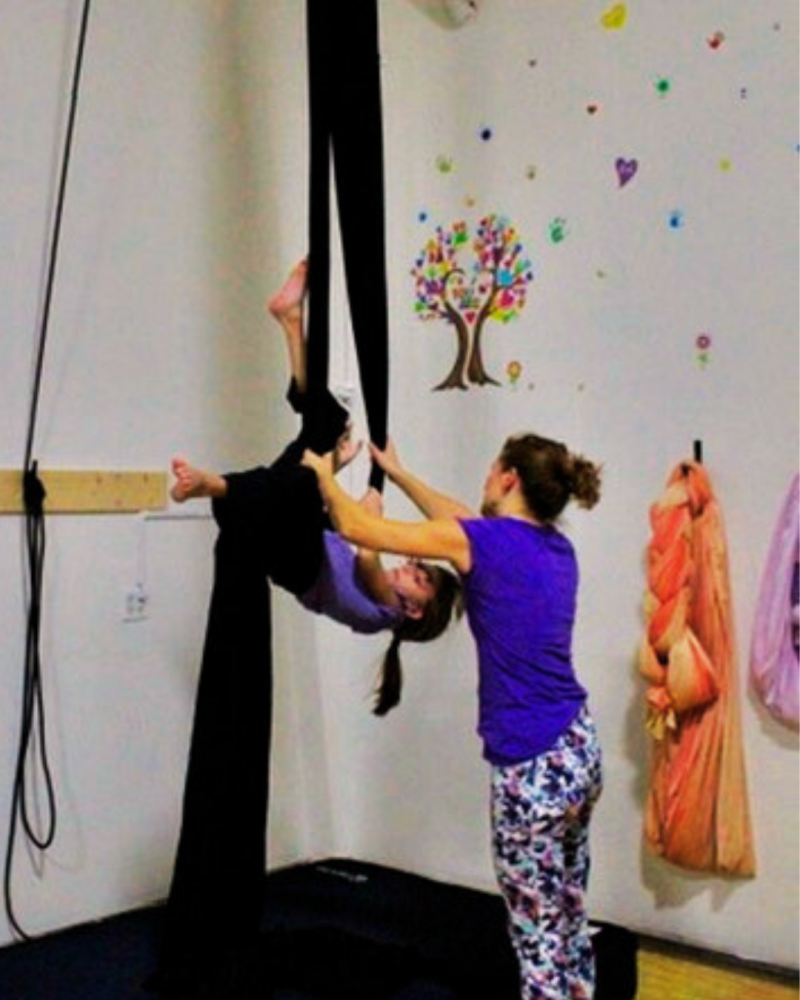
At Eternal Aerial Arts, safety isn't just a rule we enforce—it's a skill we teach. When you walk into our studio, you'll notice our instructors doing something that might seem to slow down the pace of class: they ask questions. They wait for answers. They guide students through checks that, over time, become second nature. Whether you're a parent watching your child learn to climb silks for the first time, an adult student wondering why we pause before every drop, or an aerial instructor looking to strengthen your own teaching practices, understanding the "why" behind these safety checks reveals something powerful about how we approach this beautiful, challenging art form.
The Philosophy: Safety as a Learned Skill
Many people think of safety in aerial arts as something that happens to students—instructors enforcing rules, maintaining equipment, setting boundaries. And while those elements are absolutely critical (we maintain 8-12" thick mats as standard, far exceeding the 2" mats some studios use, and all our instructors hold SafeSport certifications, concussion training, and first aid/CPR credentials), we believe safety is most effective when it becomes something students do for themselves.
This shift from external enforcement to internal awareness doesn't happen by accident. It's cultivated through consistent, patient teaching practices that build safety consciousness into the foundation of every skill. When students learn to identify risks, self-correct, and advocate for their own needs from day one, they develop a relationship with aerial arts that honors both the thrill of the discipline and the respect it demands.
The Practice: What Safety Checks Look Like in Action
Mat Placement and Spatial Awareness
One of the first safety checks our students learn seems deceptively simple: ensuring their mat is directly under the rigging point. For young students just starting out, an instructor might guide them through this check before every skill. "Look up at your rigging point. Now look down at your mat. Are you in the center?"
Over weeks and months of practice, something remarkable happens. Students begin adjusting their mats instinctively. They feel when a mat has shifted during a previous skill. They notice when they've kicked the apparatus slightly off-center. This isn't just about preventing falls—though that's certainly important. It's about developing proprioceptive awareness, understanding how their body moves in space relative to fixed points above and below them.
For our competitive students, this spatial awareness translates directly to performance scores. Control of apparatus is a key evaluation criterion in competitions, and students who have internalized center awareness can make micro-adjustments mid-sequence without conscious thought. The safety habit becomes a competitive advantage.
Descent Testing and Progressive Height Training
When students first learn to climb, their eyes naturally look up. The top of the silks, the high point of the rope—that's the goal, right? But at Eternal Aerial Arts, we know that what goes up must come down safely. That's why we implement descent testing and progressive height training for new climbers.
For a specified period when students are learning to climb, we lower rigging using our pulley systems to limit height. We also limit the number of climbs students can take in a single climb. This isn't a punishment or a sign that we don't believe in their abilities. Instead, it's a recognition that controlled descent requires different muscle engagement and mental focus than climbing up. Students must demonstrate they can come down as safely and deliberately as they went up before they earn the privilege of greater heights.
This approach has multiple benefits. First, it prevents the fatigue-related injuries that occur when students climb repeatedly without adequate rest, then attempt a descent with shaking, exhausted muscles. Second, it builds confidence. Students who know they can manage their descent don't freeze at the top of the apparatus, uncertain how to get back down. Third, it teaches pacing and self-awareness—skills that serve aerialists throughout their entire practice.
Parents often ask us about this progression, especially if their child is eager to climb higher, faster. We explain that this measured approach is actually what allows students to advance safely and sustainably. We've never had a student injured during descent when following these protocols, and we've seen countless students develop the strength and control that allows them to train for years without burnout or injury.
The Critical Wrap Check
Perhaps no safety practice we teach is more important than the wrap check. Before any drop, inversion, or move where the wrap will hold a student's weight, we require students to ask their instructor to verify the wrap is correct. We also encourage students to think through their wrapping process, essentially performing a mental self-check before seeking instructor confirmation.
This double-check system might seem redundant. After all, if the instructor is checking anyway, why have students self-assess first? The answer lies in building neural pathways. When students mentally rehearse their wrapping sequence and identify their own potential errors before instructor review, they're developing the expertise to eventually wrap independently with confidence. They're learning the feel of a correct wrap, the visual cues that indicate proper positioning, the subtle differences between variations that look similar but function very differently.
I learned the life-saving importance of this practice during a performance at a local nursing home. One of my students, normally meticulous in her preparation, wrapped incorrectly for a drop due to performance nerves. Because I maintain constant visual supervision of my students during performances—just as I do during class wrap checks—I was able to stop her mid-performance before she executed the drop. At 16 feet in the air, an incorrect wrap could have resulted in a catastrophic fall.
Was it embarrassing for her in that moment? Yes. Were her parents grateful? Absolutely. More importantly, the experience reinforced for this student—and for everyone on our performance team—why we practice wrap checks hundreds of times in training. When the pressure is on, when nerves are high, when the environment changes, that practiced protocol becomes a safety net.
For students who compete regionally and nationally, this repetitive verification process creates something invaluable: proprioceptive confidence. After hundreds of self-checks during training, these students know the feel of a correct wrap so intimately that they don't hesitate when it's time to execute. That confidence and security translates directly to better execution and higher scores.
The Body Check-In
Before and during every class, our instructors ask students a question that might seem overly simple: "How are you doing?" But we're not asking for a polite "fine, thanks." We're asking students to genuinely assess their bodies.
Are your hands sore from doing this move repetively? Do you need to switch sides to give your dominant ankle a break? Are your arms feeling fatigued? Do you need to take a break with a more floor-bound skill building before continuing on?
This practice serves multiple purposes. For young students, it builds body literacy—the ability to identify and communicate physical sensations before they become injuries. For adult students returning to fitness or managing existing conditions, it creates permission to advocate for their needs without embarrassment. For competitive students, it develops the self-awareness necessary to train at high intensity while avoiding overuse injuries that could sideline them during peak competition season.
We also address injury-concerned areas explicitly. If a student mentions ongoing ankle instability, we incorporate that awareness into conditioning, skill selection and progression. If someone is managing a shoulder issue, we adapt grips and transitions. This individualized attention within group class settings is possible because we've created a studio culture where checking in isn't a sign of weakness—it's a sign of professionalism.
Why These Practices Take Time (And Why That's Worth It)
For instructors, implementing consistent safety checks requires discipline and time management. There's always pressure to move through curriculum, to keep class exciting, to let advanced students push further faster. When you're juggling multiple students at different levels, adding systematic check-ins can feel like it's slowing everything down.
But here's what we've learned at Eternal Aerial Arts: the time invested in these practices at the beginning of a student's journey pays exponential dividends. Students who learn these protocols from day one don't just follow rules—they internalize principles. They become partners in their own safety rather than passive recipients of instruction.
Moreover, these practices actually save time in the long run. When students self-correct mat placement, you're not stopping class repeatedly to reposition equipment. When students can accurately self-assess their wraps before instructor verification, the confirmation process is faster. When students communicate their physical needs proactively, you prevent the class disruptions that come from injuries or students pushing through pain to the point of inability to continue.
For instructors at other studios considering implementing similar protocols, start small. Choose one safety check to introduce systematically for a month. Model it, explain it, make it non-negotiable. Then add another. Over time, these practices weave together into a comprehensive safety culture that becomes the foundation of everything you teach.
The Long-Term Impact: Building Aerialists Who Last
We've had families come to Eternal Aerial Arts specifically seeking our safety-forward approach. They've left studios where mats were optional, where instructors didn't ask about injuries, where students were encouraged to "push through" discomfort without assessment. These families were looking for something different—not a place that would limit their children's potential, but a place that would help them reach that potential sustainably.
Our adult students, many of whom have experienced injury or dismissal of their concerns at other fitness facilities, express similar relief. They appreciate knowing that we care about their longevity, not just their performance in a single class. They value being asked how they're doing, being given permission to modify, being taught to recognize their own limits.
And for our competitive students, the ones performing at national competitions or performing on silks 20 feet in the air at community events, these safety habits are quite literally what keep them in the air. The body awareness, the wrap confidence, the spatial control—these aren't separate from their artistry. They're what makes their artistry possible.
For Parents: What to Look for in an Aerial Studio
If you're evaluating aerial studios for your child (or for yourself), the presence or absence of systematic safety checks tells you a great deal about an instructors' philosophy and priorities. Here are questions worth asking:
- What mat thickness do you use, and are mats required for all apparatus work? (Industry standard for competitions and good insurance providers is 8" minimum; we use 8-12")
- How do you approach teaching new climbers about safe descent?
- What is your protocol for checking wraps before drops?
- What certifications and training do your instructors hold?
- How do you handle students who want to advance quickly versus students who need more time?
- What's your policy on training when students are experiencing pain or managing injuries?
Studios that have clear, consistent answers to these questions—and more importantly, that can articulate why these practices matter—are studios that have thought deeply about how to help students thrive long-term.
For Instructors: The Courage to Slow Down
Teaching aerial arts is an enormous responsibility. We're guiding students through an activity that is inherently risky, physically demanding, and requires significant trust. The temptation to move fast, to impress students with quick progression, to skip the "boring" parts of class is real.
But I encourage you to find the courage to slow down. To ask the questions even when you're running behind schedule. To verify the wrap even when you're pretty sure it's correct. To limit height even when students beg to go higher. To require the mat check even though it's the fifteenth time that class.
These practices aren't about doubting your students' abilities. They're about honoring the seriousness of what we teach and respecting the trust students place in us. They're about building aerialists who will still be training joyfully ten years from now, not just students who can perform impressive tricks today but burn out or get injured tomorrow.
Safety as Love in Action
Ultimately, that's what these safety checks represent: love in action. Love for the art form, love for our students, love for the community we're building together. When we teach students to place their mat correctly, to assess their descent capabilities, to verify their wraps, to listen to their bodies, we're not just preventing injuries. We're teaching them that they are worth protecting. That their bodies deserve respect. That skill and safety aren't opposites—they're partners.
At Eternal Aerial Arts, we believe aerial arts should be a place to belong, whether you're seven or sixty-seven, whether you're training for nationals or just looking for a supportive fitness community, whether you started yesterday or years ago. These safety practices are how we make that belonging possible—not just for a season, but for a lifetime.
Because the most important trick we can teach isn't a drop or a climb or an inversion. It's the knowledge that you can trust yourself, that you've developed the awareness and skills to participate in this magnificent art form safely, and that you have instructors who will always, always have your back.
Even if that means stopping you mid-performance at a nursing home when your wrap isn't quite right.
Especially then.
At Eternal Aerial Arts, we offer classes in silks, lyra, rope, hammock, and bungee for students ages 7 and up, from beginners to nationally competitive athletes. All our instructors hold SafeSport certifications, concussion training, first aid and CPR credentials, and undergo regular in-house training to continue developing their teaching and aerial skills. We're committed to providing a safe, nurturing environment where students can discover their potential and develop their artistry. Visit us to experience the difference a safety-forward approach makes.
Add comment
Comments