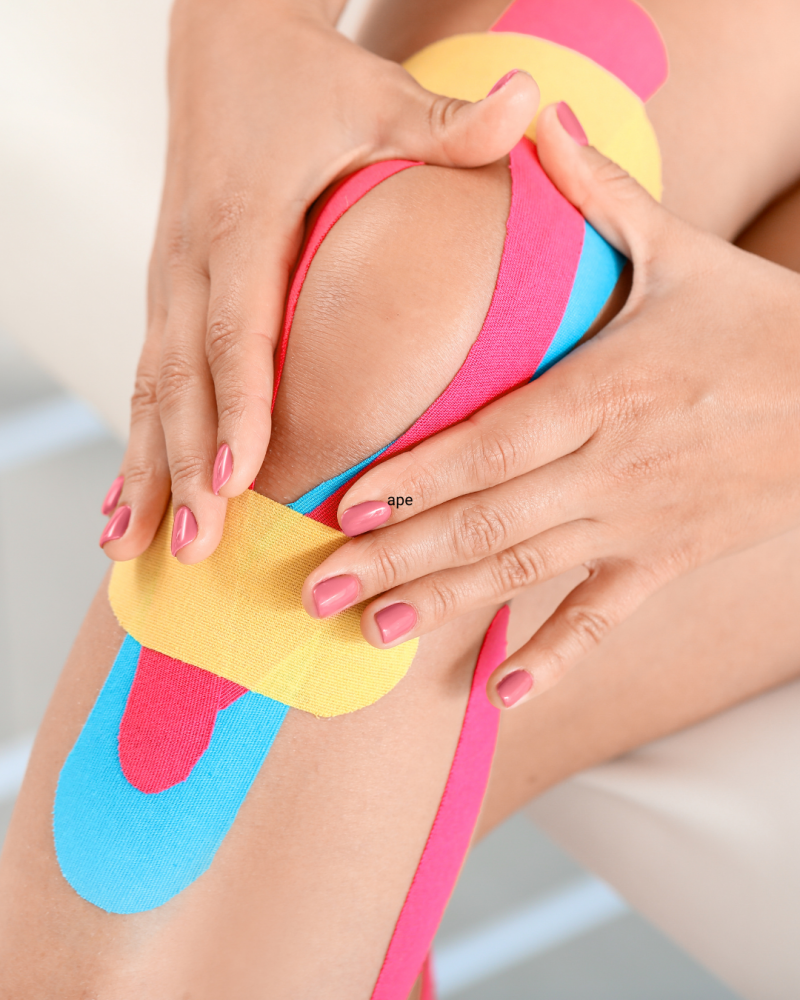
Starting last month, I embarked on what would become a marathon project at Eternal Aerial Arts: retaping all nine studio lyras. Night after night, I'd dedicate about three hours to painstakingly removing old grip tape from one hoop and applying fresh tape. The repetitive pulling, gripping, and finger work—multiplied across nine apparatuses after teaching all day at the studio—left my hands screaming. By the third or fourth lyra, the knuckle joint on my middle left finger was sore and angry. By the sixth, I it was starting to dislocate at times. I knew immediately what I needed: my trusty roll of kinesiology tape.
I've become quite proficient at creative taping solutions over the years. For this particular injury, I started at my wrist and ran two strips up each side of my hand. Just after the tape passed over the inflamed knuckle, I split each piece in half, spiraling the divided ends around my finger from opposite sides. I finished by anchoring everything with a wrap around my wrist and another around the top of the finer. Within minutes, the throbbing had subsided enough that I could face keep teaching. The following day, with the tape still firmly in place, I was back to training without a second thought about that finger and a few weeks after that I was healed enough to finish taping up the final lyras.
This is the reality of being an aerialist—especially one navigating the challenges of hypermobile Ehlers-Danlos Syndrome (EDS). But here's what I've learned over three years of using kinesiology tape: you don't need to have a connective tissue disorder to benefit from this simple, accessible tool.
Understanding EDS and Hypermobility in Aerial Arts
For those unfamiliar, Ehlers-Danlos Syndrome is a group of inherited connective tissue disorders affecting the body's collagen production. Hypermobile EDS, the most common type, is characterized by joints that move beyond normal ranges, along with chronic pain, particularly in larger, more mobile joints like shoulders, knees, and hips. Research indicates that between 0.75% and 2% of the population has hEDS, though many remain undiagnosed.
I've written before about how aerial arts has helped me manage my EDS, but the relationship between hypermobility and aerial training isn't always straightforward. While our hypermobile joints might give us some initial advantages in flexibility-based movements, they also mean our joints lack the natural stability that typical connective tissue provides. Every inversion, every drop, every sustained hold requires our muscles to work overtime to compensate for ligaments that can't quite do their job.
But here's the thing: even if you don't have EDS or diagnosed hypermobility, aerial training places extraordinary demands on your joints. When you're drilling a new skill for an upcoming performance or pushing through intense competition prep, you're asking your body to perform the same movement pattern dozens—sometimes hundreds—of times. Those joints need support.
What is Kinesiology Tape and How Does It Work?
Kinesiology tape (often called k-tape or KT tape, after the popular brand name) was developed in the 1970s by Japanese chiropractor Dr. Kenzo Kase. Unlike rigid athletic tape that restricts movement, kinesiology tape is an elastic cotton strip with an acrylic adhesive that stretches 130-140% of its original length. This elasticity allows full range of motion while still providing support.
The tape's mechanism isn't about physically holding joints in place the way traditional athletic tape does. Instead, it works through neurological feedback. When applied to the skin, the tape provides tactile input that enhances proprioception—your body's awareness of where it is in space. For people with hypermobility, whose proprioception is often impaired, this feedback can be transformative. For any athlete repeating movements to the point of overuse, it offers gentle reminders to recruit the right muscles and maintain proper joint alignment.
The research on kinesiology tape presents a nuanced picture. A comprehensive scoping review examining athletic outcomes found that 54% of publications concluded KT was not effective, while 46% found evidence supporting its effectiveness. However, when we look specifically at pain management and joint support—the primary concerns for most aerialists—the evidence becomes more compelling. Studies examining individuals with hypermobile EDS and shoulder pain found that kinesiology taping provided temporary but significant improvements in pain and function up to 48 hours post-application. One study noted that patients found any pain relief welcome given the near-constant multi-joint discomfort characteristic of hEDS.
What's particularly relevant for aerialists is that the tape appears most effective for improving proprioception and reducing pain in specific injured cohorts, even if it doesn't dramatically enhance athletic performance in healthy populations. Since we're often dealing with overused joints and repetitive strain rather than seeking performance enhancement, this makes kinesiology tape an ideal tool for our community.
My Experience: Taping Through Training and Performance
I had my introduction to strategic taping about three years ago when I was working on a silks routine that featured a particularly aggressive knee drop. Every time I practiced that section—and certainly every time I performed it—I knew my right knee would take the brunt of the impact. So I developed a ritual: whenever I planned to drill that routine or had a performance scheduled, I'd tape that knee.
The difference was remarkable. Not only did the tape reduce the immediate discomfort during and after the drop, but it also seemed to prevent the lingering soreness that would typically keep me from training. I could train more consistently, which meant I could actually improve rather than constantly cycling through injury and recovery.
What I particularly appreciate is that kinesiology tape doesn't restrict my movement the way braces or rigid supports would. Aerial arts demands full range of motion—we need our joints to move freely through sometimes extreme positions. The tape provides just enough feedback and support to help my muscles engage properly without limiting the flexibility that silks work requires.
When and How Aerialists Should Consider Taping
Kinesiology tape shines in several specific scenarios common to aerial training:
During intensive training cycles: When you're preparing for a performance or competition and need to repeat movements far more frequently than usual, taping can help prevent overuse injuries before they start. Think of it as pre-emptive support for joints you know will be stressed.
For chronic weak spots: Many of us have that one joint that always seems to be the first to complain. For me, it's my knees. For you, it might be your left wrist or both ankles. Regular taping of these vulnerable areas can help you train more consistently.
When recovering from mild injuries: If you've strained something but it's not severe enough to keep you completely out of the studio, tape can provide the support you need to continue modified training while healing.
For hypermobile individuals: If you have diagnosed or suspected hypermobility, kinesiology tape can significantly improve proprioception and joint awareness, helping prevent the subluxations and dislocations that make training frustrating and sometimes dangerous.
Learning to Tape: Resources and Techniques
The beauty of kinesiology tape is that it's designed for self-application. While working with a physical therapist or chiropractor can be helpful initially, most people can learn to tape themselves effectively using online resources.
KT Tape's Website and App: The official KT Tape website (kttape.com) offers the most comprehensive collection of taping tutorials, with over 45 different applications covering virtually every muscle, joint, and tendon. Their free mobile app breaks videos into step-by-step segments that repeat until you're ready to move to the next step—perfect for following along while taping yourself. While I don't exclusively use KT brand tape, their educational resources are unmatched.
YouTube Channels: Several excellent channels provide detailed taping tutorials:
- The official KT Tape YouTube channel features high-quality videos for specific injuries and body parts
- RockTape's channel offers similar comprehensive tutorials along with educational content about kinesiology and movement
- SportTape has 25+ easy-to-follow videos covering both kinesiology taping and sports strapping techniques
When you're first learning, I recommend starting with simple applications for commonly taped areas like knees, shoulders, or wrists. The basic "I" strip (straight application) and "Y" strip (split application) account for about 80% of all taping applications, so mastering these will serve you well.
Important Application Guidelines
Based on my three years of experience and guidance from the physical therapists and chiropractors I've worked with for my daughter's EDS, here are essential tips:
Skin preparation is crucial. Clean, dry skin free from lotions or oils ensures the best adhesion. I clean the area before applying tape—it helps the tape last the full 3-5 days.
Apply joints in a flexed position. If you're taping a knee or elbow, bend it partially while applying the tape. If you apply it while the joint is extended, the tape will more likely pull off as you move.
Never stretch the anchors. The first and last two inches of any tape application should be applied without stretch. These anchor points are crucial for keeping the tape in place.
For sensitive skin or EDS: Apply the tape with minimal stretch—25-50% is plenty. Those of us with EDS have fragile skin, and too much tension can cause blistering or tears. In studies of hEDS patients using kinesiology tape, about 5% experienced minor skin reactions that resolved within 2-4 days after removal. I've found that leaving the tape on no more than 3 days and removing it in the shower while the skin is warm and moist minimizes irritation.
Firmly rub the tape after application to activate the heat-sensitive adhesive. This significantly improves how long it stays in place.
When Not to Tape: Important Cautions
While kinesiology tape is remarkably safe, it's not appropriate for every situation. I've also written about recognizing when to rest versus push through, and that wisdom applies here too.
Don't tape through serious injuries. If you have sharp pain, significant swelling, or suspect a more severe injury like a tear or fracture, see a medical professional. Tape is not a substitute for proper diagnosis and treatment.
Pain is information. If taping allows you to train without pain but the underlying issue keeps worsening, you're ignoring your body's messages. Tape should support healing and prevention, not enable you to ignore injuries.
Be aware of allergic reactions. Some people react to the adhesive. Start with a small test piece if you have sensitive skin or known adhesives.
Pregnancy and medical conditions: Avoid abdominal taping if pregnant, and consult your doctor if you have any medical conditions that might be affected by increased circulation or lymphatic flow.
For parents of young aerialists or instructors working with students: teach them to listen to their bodies. Tape can be a wonderful tool for allowing continued training during minor issues, but it should never become a way to push through pain that signals genuine injury.
Finding Your Taping Practice
I don't have a preferred brand—I've found that various generic options work just as well as name brands, though KT Tape's educational resources make them worth mentioning specifically. The key is finding tape that works for your skin and activity level. Some aerialists prefer synthetic tapes like KT Tape Pro for their water resistance and durability during intensive training. Others do better with cotton-based options that may be gentler on sensitive skin.
It typically takes 3-4 applications before you'll feel confident with your taping technique, so don't be discouraged if your first attempts look a bit haphazard. Even imperfect taping can provide benefit—you'd be hard-pressed to actually hurt yourself with poorly applied kinesiology tape.
What I've learned through three years of taping is that this simple tool can be the difference between training consistently and constantly sitting out nursing overuse injuries. It's not a miracle cure, and the research acknowledges its limitations. But for those of us who need that extra support—whether because of hypermobile joints, intensive training schedules, or just the incredible demands we place on our bodies as aerialists—kinesiology tape offers an accessible, affordable way to keep doing what we love.
Now, if you'll excuse me, I need to retape my finger before tonight's silks class.
Peggy Ployhar, Owner - Eternal Aerial Arts
Have you used kinesiology tape for aerial training? What joints do you tape most often? Share your experiences in the comments below—I'd love to hear what techniques work for you!
Add comment
Comments