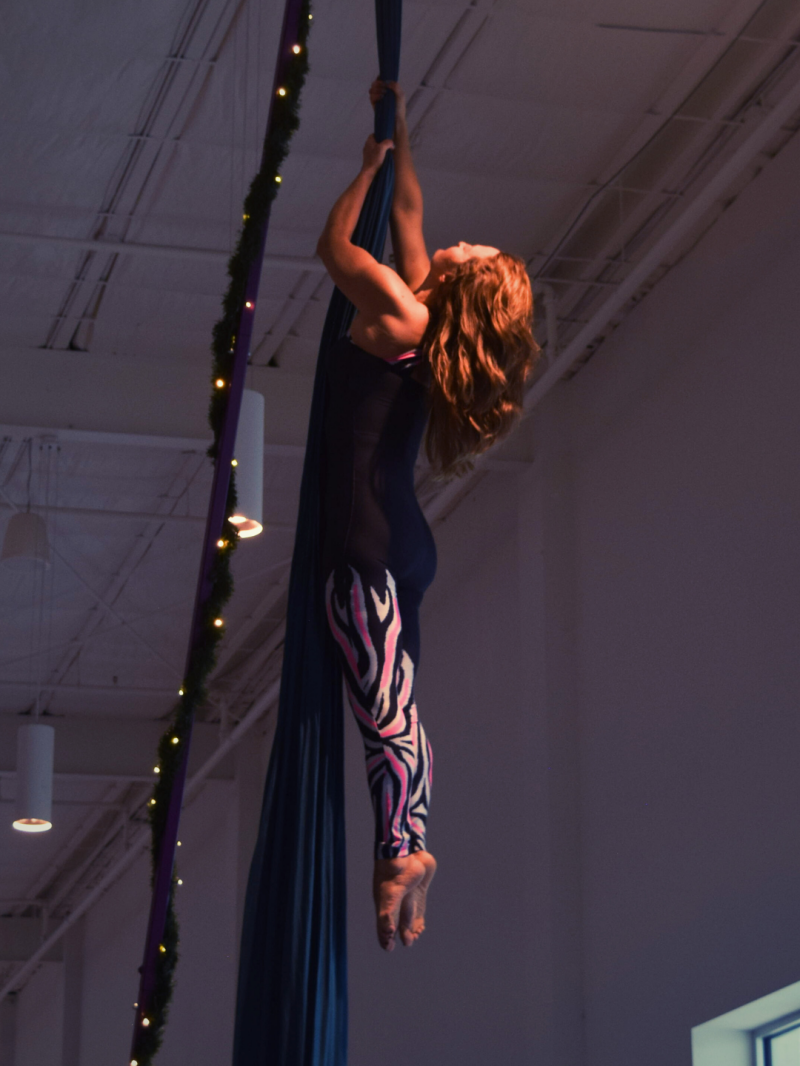
My Personal Journey with Hypermobility
I'm Peggy Ployhar, owner of Eternal Aerial Arts, and I'm about to share something deeply personal that I've only recently begun to understand about my own body. While I've never been formally diagnosed, I strongly suspect I have Ehlers-Danlos Syndrome (EDS)—the hereditary connective tissue disorder that two of my adult children have been diagnosed with. The puzzle pieces have always been there: POTS symptoms since my 20s, hypermobility that I thought was just being "flexible," chronic joint pain, and now, watching my children navigate their diagnoses, I see my own struggles reflected back at me.
But here's the remarkable part of my story: since starting aerial arts at age 48 and now at 55, I've essentially reversed many of the debilitating symptoms I lived with for decades. My joint pain has almost completely disappeared. My heart no longer races when I change positions. I have more endurance and less muscle fatigue than most people without EDS. And the more I train, the better I feel—which is exactly opposite of what conventional wisdom might suggest.
This is my journey of discovering that the very activity that seemed impossible for someone with my symptoms became the key to managing them.
Before Aerial: A Body That Didn't Work Right
Looking back now with the knowledge I have about EDS, so many things make sense. I struggled to walk because of hip issues. Riding a bike was impossible because of knee problems. I had no endurance, and even mild cardio training left my heart struggling in ways that seemed disproportionate to the effort. I was always hypermobile—I could bend and stretch in ways others couldn't—but instead of this being an advantage, it seemed to come with a cost: chronic pain, joint instability, and a body that felt like it was working against me.
I've always been hypermobile, always had POTS symptoms (though I didn't know that's what they were called), and always dealt with joint pain that doctors couldn't quite explain. When my children were diagnosed with EDS as adults, the genetic pieces fell into place. Between my husband and me, I was clearly the one who passed this condition to them.
The Unexpected Beginning
Thirty years ago, I was a college cheerleader—strong, capable, athletic. But three decades later, that felt like a different person entirely. I longed to feel that way again, but my body seemed to have other plans.
Then my daughter started taking aerial classes, and the studio opened an adult class. I was invited to try it. Despite my limitations—or perhaps because I was desperate to reclaim some sense of physical capability—I said yes.
Those early days were humbling. I couldn't do a single pull-up. My lack of stamina was embarrassing. My immobility had reduced my back and leg flexibility to the point where I was severely limited in which poses I could even attempt to hold. The irony wasn't lost on me: I was hypermobile in my joints but inflexible in my muscles and fascia. My connective tissue was too loose, but everything else was too tight.
But something kept me coming back.
The Turning Point: COVID, Cancer, and Commitment
In 2020, as I was recovering from breast cancer during the COVID pandemic, I made a decision that would change my life. I decided to really commit to aerial training. I wasn't just going to attend a class once a week—I was going to train seriously.
I also changed my diet to decrease inflammation, reduced my stress levels, and prioritized better sleep. But the aerial training became the cornerstone of my recovery and, unknowingly at the time, my EDS management.
My home training routine became sacred: 20-45 minutes of conditioning on the silks, followed by another 20-45 minutes working on skills. When I moved from training once a week to 4-6 times per week, I saw dramatic improvements across every measure of my health.
The Science Behind What Was Happening to My Body
As I later researched EDS and exercise, I discovered that what I was experiencing had a solid scientific foundation. Research shows that people with EDS have fundamental issues with proprioception—the body's sense of where it is in space. Studies have found that proprioceptive deficits in EDS are correctable with training and visual compensation, and that while EDS patients can recalibrate their proprioceptive sense to the same extent as healthy controls through sensorimotor adaptation tasks, they have greater variability when relying solely on proprioceptive information.
Aerial work is essentially intensive proprioceptive training. Every time I grip the silk, invert my body, or transition between poses, I'm giving my brain better information about where my body is in space. The visual feedback of seeing myself in the mirror, combined with the tactile feedback of the fabric, creates exactly the kind of multi-sensory input that research shows can improve proprioceptive function in people with hypermobility.
The Muscle-Connective Tissue Connection
One of the most fascinating discoveries I made was learning why more training makes me feel better while rest makes me feel worse. Research confirms what I experienced: reduced joint proprioception and the tendency for minor subluxations from daily activities in EDS results in learned motor patterns that emphasize short jerky motions rather than sustained precise muscular contractions, and muscle function is affected by connective tissue distensibility.
Here's what I observed in my own body: when my muscles weaken from inactivity, the connective tissue in my body is in higher demand to help me move. A simple long car ride followed by standing up after hours of resting can cause me to pull a muscle. But doing a complex routine or performance on the silks doesn't affect me this way.
The muscle replaces the workload of the connective tissue that's compromised by EDS. I even read somewhere that men are less likely to get an EDS diagnosis simply because they generally have more muscle mass—the muscle literally compensates for the faulty connective tissue. This explained so much about my experience.
Studies support this observation. Research on classic EDS patients undergoing strength training found that training increased tendon stiffness in three individuals with genetically verified EDS, suggesting that despite the genetic error, connective tissue in these patients is capable of adapting to physical training. My body was essentially building its own internal support system.
The POTS Connection
My POTS symptoms—the racing heart, the dizziness when changing positions—had been part of my life since my 20s. Research shows that exercise training, particularly programs that include recumbent exercises and gradual upright training, can significantly improve symptoms in POTS patients by enhancing cardiovascular adaptation.
Aerial work, with its constant inversions and position changes, was like targeted cardiovascular training for someone with POTS. It took multiple years for me to reach the point where I don't see stars when I invert or have to catch my breath after a simple routine. But the adaptation happened. My heart learned to regulate blood flow in all orientations, not just upright.
The Paradox of Hypermobility and Immobility
One of the strangest aspects of having suspected EDS is being simultaneously too mobile and too immobile. My joints were hypermobile, but my muscles and fascia were tight and inflexible. Research shows that women with hypermobile EDS have significantly lower maximal muscle strength and muscle strength endurance compared to healthy controls, along with greater physical impairment.
Aerial work addressed both issues simultaneously. The strength-building aspects developed the muscle support my loose joints desperately needed. The flexibility work—all that reaching, extending, and flowing through poses—restored the mobility my tight muscles had lost. Studies emphasize that functional strength training is necessary for individuals with hEDS and hypermobility spectrum disorders, and aerial provided exactly that.
The Dramatic Improvements
The changes weren't immediate, but they were profound:
Joint Pain: From constant, debilitating pain to almost none. The chronic hip and knee issues that made walking and biking difficult have largely resolved. When I do experience any discomfort, it's manageable and temporary.
POTS Symptoms: My heart no longer races every time I change position. The inversions that initially left me seeing stars and breathless now feel natural. My cardiovascular system has adapted to handling blood flow in any orientation.
Endurance and Stamina: From struggling with mild cardio to being able to train for 40-90 minutes daily. I have less muscle fatigue than most of my counterparts who don't have EDS.
Strength: From zero pull-ups to having the upper body, core, and grip strength to perform complex aerial routines and even teach others.
Flexibility: From limited range of motion to being able to access poses and transitions that require both strength and flexibility working together.
The Rest Paradox: I discovered that the more I train, the better I feel. Taking breaks makes me vulnerable to injury. Daily training keeps my muscles strong enough to support my unstable joints.
The Daily Training Protocol That Changed Everything
People often ask me about my training schedule, especially when they learn I train almost daily. For most people, that would lead to overtraining and breakdown. For me, with suspected EDS, it's what keeps me functional.
A typical session includes:
- 20-45 minutes of conditioning (building the muscle support my joints need)
- 20-45 minutes of skills work (challenging my proprioception and cardiovascular system)
- Focus on both sides of my body equally (bilateral training for improved proprioceptive feedback)
- Constant position changes and inversions (cardiovascular adaptation and vestibular training)
- Grip work without aids as much as possible (building the muscle compensation I need)
When I'm consistent with this schedule, I feel younger at 55 than I did at 25. When I take extended breaks—even just a few days—I notice the difference. My joints feel less stable. Simple movements become harder. The muscle support weakens and my faulty connective tissue has to take on more load.
Supporting My Children's Journeys
When my adult children were diagnosed with EDS, I finally had a name for what I'd been experiencing. While my journey was discovering aerial arts helped manage symptoms I didn't understand, I can now support them with knowledge I wish I'd had earlier.
I encourage them to work out and come to the studio to train with me when they're home. I share what I've learned about the muscle-connective tissue relationship, about how consistent training can build the internal support system their bodies need. I hope they won't spend decades in pain before discovering what their bodies are capable of with the right kind of movement.
Watching them navigate their diagnoses while having the benefit of my experience is bittersweet. I can't give them back the years they struggled, but I can show them that their diagnosis doesn't have to define their limitations.
The Moments of Realization
There wasn't one single moment when I thought "this is reversing my EDS symptoms." Instead, it was a gradual accumulation of conversations and observations.
I'd talk with my adult students, and I'd find myself constantly referring back to things I did at the studio that seemed to help. "Since I started inverting regularly, my dizziness has decreased." "When I train consistently, my joints don't hurt." "The more I grip the silks, the stronger my hands feel in daily life."
My daughter and I would discuss aerial, and she'd mention something about her EDS symptoms, and I'd realize that I used to have that same symptom but didn't anymore. The longer I was conscious of these patterns, the more I realized that aerial training was helping in ways I hadn't initially recognized.
It was like watching my own body rewrite its operating manual, one training session at a time.
What I Want Others with EDS or Hypermobility to Know
If you have diagnosed or suspected EDS, hypermobility spectrum disorder, or even just hypermobile joints, I want you to know that aerial arts can be safe and transformative for you. But it requires finding an instructor who understands what EDS is and how it affects aerial practice.
Find an Instructor Who Understands
You need someone who knows that:
- Hypermobility can initially limit aerial work. What looks like an advantage (extreme flexibility) is actually a challenge. You'll need to learn where your safe range of motion ends, even if you can physically go further.
- Joint issues are real. Your instructor should understand about possible subluxations, that you might need extra support in certain positions, and that what's safe for other students might not be safe for you.
- Inversions might cause you to black out initially. This is the POTS talking. A good instructor will help you build up gradually and won't push you before your cardiovascular system is ready.
- You might slide out of locks that are typically safe. Your hypermobile joints and loose connective tissue mean you can slip out of positions that hold other students securely. Extra wraps, different techniques, and modified progressions are essential.
The Daily Training Approach
For most people, daily aerial training would be too much. For those of us with EDS or hypermobility, it might be exactly what we need. The key is understanding that our bodies work differently:
- Muscle weakness makes our connective tissue work harder, leading to pain and injury
- Building and maintaining muscle mass provides the support our faulty connective tissue can't
- Consistent training keeps that muscle support strong
- Rest periods allow the muscle to weaken, putting stress back on the problematic connective tissue
The Proprioceptive Training Advantage
Aerial arts provides intensive proprioceptive training in a way few other activities can match. Research shows that physical therapists can help people with hypermobility improve proprioception through manual and visual cues and modified exercises. Aerial work naturally provides all of these:
- Visual feedback from mirrors and watching your body move through space
- Tactile feedback from the fabric against your skin
- Constant challenges to your sense of where your body is in space
- Bilateral coordination that engages both hemispheres of your brain
- Progressive difficulty that keeps challenging your proprioceptive system
Start Where You Are
I couldn't do a single pull-up when I started. My flexibility was limited despite my hypermobile joints. I got dizzy with inversions. I struggled with stamina. None of that stopped me from beginning, and none of it should stop you.
The hammock or an aerial conditioning class is a perfect starting point for people with EDS—it provides support while you build strength. Low-level work where your feet can touch the ground builds confidence. Simple wraps and holds build grip strength without requiring you to support your full body weight immediately.
Progress slowly. Build strength before attempting advanced moves. Listen to your body, but also understand that some cardiovascular adaptation discomfort (the heart racing with inversions) is normal and will improve with consistent training.
The Gift of Understanding
Looking back, I spent so many years thinking my body was simply broken. The joint pain, the POTS symptoms, the paradox of being hypermobile yet inflexible—none of it made sense until I understood the connective tissue disorder underlying it all.
Aerial arts didn't cure my suspected EDS. The genetic condition is still there. But aerial training gave my body the tools to compensate: muscle strength to replace faulty connective tissue support, cardiovascular adaptation to manage POTS symptoms, proprioceptive training to improve body awareness, and the confidence that comes from discovering my body is capable of far more than I imagined.
At 55, I feel younger and healthier than I did at 25, and certainly more capable than I did at 48 when I started this journey. I can perform complex aerial routines. I teach others. I train almost daily with minimal pain and maximum joy.
If you're reading this and seeing yourself in my story—the hypermobility, the joint pain, the POTS symptoms, the sense that your body doesn't work quite right—I want you to know that you're not broken. Your body just needs the right kind of support, and for me, that support came wrapped in silk, hanging from the ceiling.
The journey won't be easy, and it won't be quick. It took me years to fully reverse my symptoms. But every training session is an investment in your body's ability to compensate for what genetics gave you. Every grip builds the support your joints need. Every inversion trains your cardiovascular system. Every sequence improves your proprioception.
Your hypermobile joints aren't a barrier to aerial arts. With the right instructor and the right approach, they might be exactly why you need it most.
Peggy
Owner, Eternal Aerial Arts
Living proof that EDS symptoms can be managed through movement
Disclaimer: This article reflects my personal experience with suspected EDS and is not medical advice. If you have diagnosed or suspected EDS, work with your healthcare team and find an instructor experienced with connective tissue disorders before beginning aerial training.
Add comment
Comments