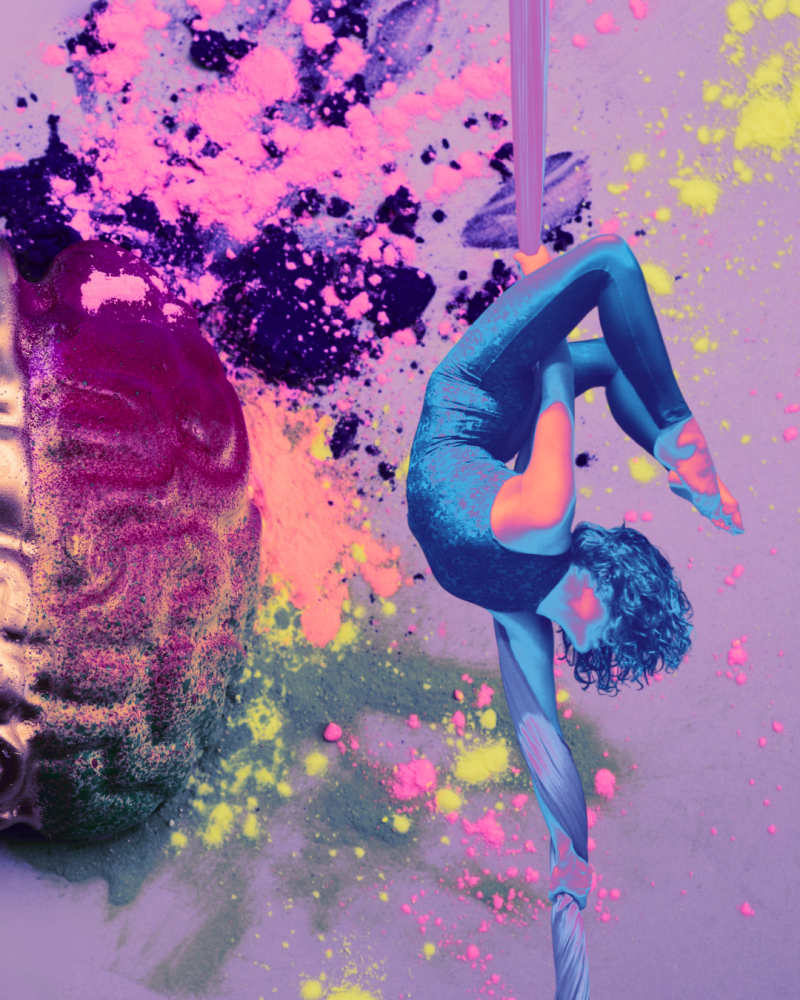
"I love coming to class because it keeps my mind sharp," one of my students continues to tell me every time she comes to class. She's in her 60s, has been doing aerial for over two years, and makes it to class multiple times every single week without fail. "I occasionally still go to the gym," she tells me, "but it is always so boring. Counting reps, doing the same exercises over and over. Here, every class is a puzzle. I have to think about where my body goes, which hand to hold, how to get into and out of wraps. My brain gets a workout along with my muscles—and I love it."
She's not alone in this observation. Multiple students over 60 have shared similar sentiments with me: aerial arts provides something that traditional fitness simply can't—a mental workout that matches the physical challenge.
As the owner of Eternal Aerial Arts and someone who started my aerial journey at 48, I never imagined that a career in owning an aerial studio would become my reality, but here I am, now in my mid-50s. But what keeps me training daily isn't just the physical benefits—it's the mental challenge that awaits me every time I step into the studio. And the science is increasingly backing up what we've experienced firsthand: aerial arts isn't just changing our bodies, it's literally rewiring our brains.
The Neuroplasticity Revolution
Neuroplasticity—the brain's remarkable ability to form new neural pathways and connections throughout life—has revolutionized our understanding of brain health and aging. For decades, scientists believed that the adult brain was relatively fixed, that cognitive decline with age was inevitable. Research over the past 20-30 years has shattered that assumption.
Physical exercise has been associated with increased neuroplasticity and neurotrophic factors, leading to improvements in brain function. Specifically, exercise triggers the production of brain-derived neurotrophic factor (BDNF), a protein crucial for brain cell growth and function. Studies show that regular physical exercise can promote a healthy, sharp brain by leading to faster processing of mental tasks, and these results are particularly encouraging because problems with processing speed are often the earliest signs of age-related cognitive decline.
But not all exercise is created equal when it comes to brain health. Research shows that engaging in diverse, stimulating activities supports brain health by promoting neuroplasticity. This is where aerial arts truly shines—it's not repetitive movement. Every skill requires you to learn something new, adapt to different orientations, and solve physical puzzles with your body.
Why Aerial Arts Is Different from Traditional Exercise
Think about a typical gym workout. You might do three sets of ten bicep curls, followed by three sets of ten squats. Your muscles get tired, you're breathing hard, but your brain? It's on autopilot. You're counting reps, maybe watching the clock, thinking about what you need to do after your workout.
Now contrast that with learning a new aerial skill. Let's take the Candy Cane Roll Up on silks—a skill we teach at the beginner level. It seems simple: get into a footlock, lean forward, place your free foot, and roll up. But the cognitive load is significant:
First, you must remember which side to hold onto once you step up into the footlock. Then you need to re-orient your body as you lean forward—your perspective shifts, and suddenly "up" isn't where you thought it was. You place your free foot and engage it in a specific way, using it to push yourself into the roll. Throughout this, you're processing proprioceptive feedback (where your body is in space), maintaining spatial awareness of the silk's position, and coordinating movements that feel completely unnatural at first.
And here's the kicker: getting out of the skill is just as mentally demanding as getting in. You must execute a one-and-a-half body turn oriented around one silk, and if you switch your hands at the wrong moment, you'll end up tangled rather than making a clean exit.
This is just one beginner skill of the 15 we teach just in our Red Level 1 curriculum for kids. As students advance, the complexity multiplies exponentially. Many wraps and transitions require you to think through sequences while upside down, often with one or both hands or legs occupied and often doing completely different things. You're essentially solving a kinetic puzzle while suspended in the air.
The Unique Cognitive Demands of Aerial Training
What makes aerial arts particularly powerful for neuroplasticity is the combination of several cognitive challenges happening simultaneously:
Spatial awareness and re-orientation. When you invert, your entire understanding of space shifts. What was up is now down. Your brain must constantly recalibrate as you move through different positions. Mind-body exercises promote cognitive function by reducing stress and improving emotional regulation, in addition to improving flexibility and balance, and aerial arts incorporates all these elements while adding the complexity of three-dimensional movement and spatial reorientation.
Memory and sequencing. Every skill is a sequence that must be memorized and executed in the correct order. Miss one step, and the entire movement falls apart. This constant practice of memorization and sequential thinking strengthens neural pathways associated with working memory.
Problem-solving in real time. When something doesn't feel right, you have to troubleshoot mid-movement. Why didn't that wrap work? Where did my hand need to be? What happens if I shift my weight differently? This active problem-solving engages the prefrontal cortex, the brain region responsible for executive function and decision-making.
Bilateral training. In aerial arts, we emphasize working both sides of the body equally. If you learn a skill on your right side, you must also master it on your left. This bilateral training is crucial for balanced brain development and helps prevent the formation of dominant-side habits that can lead to injury or imbalance.
Mindful movement. Perhaps most importantly, aerial training demands complete presence. You can't scroll through your phone or zone out while suspended in the air. This enforced mindfulness has profound effects on mental health. Research suggests that neuroplasticity exercises can lower anxiety, and many students report that aerial training serves as a destresser.
The Benefits for Different Populations
Older Adults: Maintaining Cognitive Function
Multiple students in their 50s and 60s train with us regularly, and they consistently report that aerial arts keeps their minds sharper than any other form of exercise they've tried. The science supports this. Physical exercise can prevent or delay the onset of cognitive decline and Alzheimer's disease by enhancing cerebrovascular function and hippocampal volumes.
What our older students appreciate most is the novelty factor. Dr. Budson suggests engaging in learning-based activities and trying something new to enhance neuroplasticity, as learning forms fresh neural connections. Unlike repetitive gym workouts where they're mentally checking out while counting reps, aerial classes present new challenges every single session. There's always another skill to learn, another transition to master, another way to refine a movement they thought they already knew.
Children with Dyslexia: Spatial Advantages
We've noticed something fascinating with our students who have dyslexia: they often excel at aerial arts in ways that surprise both them and their parents. While dyslexia can interfere with reading by causing difficulties with sequential processing of letters and words, these same brains often have enhanced spatial reasoning abilities.
Our students with dyslexia frequently "see" aerial sequences before their peers do. They can visualize the path of a wrap or predict how a movement will unfold in three-dimensional space more quickly and fluidly than students without dyslexia. What's a disadvantage in the classroom becomes a significant advantage in the studio. This success in a domain where their brain's wiring gives them an edge builds confidence that carries over into other areas of life.
Students with ADHD: Calming Through Movement
Research from Harvard Medical School has shown that physical exercise significantly increases levels of dopamine and norepinephrine, neurotransmitters responsible for attention and impulse control. For our students with ADHD, aerial training provides exactly the kind of stimulation their brains crave.
The movement itself is regulating. Movement therapy strengthens the vestibular system responsible for balance and spatial awareness, which is closely linked to eye movement control. Many parents report that their children with ADHD are calmer, more focused, and better able to self-regulate after aerial classes. The structured movement helps reset their nervous system in ways that traditional exercise often doesn't.
Additionally, aerial training addresses one of the key challenges many people with ADHD face: spatial awareness difficulties. By improving communication between the prefrontal cortex and other brain regions, movement therapy enhances self-regulation, focus, and cognitive processing speed. The constant practice of tracking body position in space, judging distances, and coordinating complex movements helps build skills that translate beyond the studio.
Students with Autism and Sensory Processing Differences
The vestibular input from inversions and swinging, combined with the proprioceptive feedback from wrapping and holding positions, provides exactly the kind of sensory integration that many students with autism spectrum disorder find regulating and enjoyable. The predictable structure of classes, combined with the novelty of learning new skills, offers an ideal balance for neurodivergent learners.
My Personal Experience: The Creative Challenge
Because I have Ehlers-Danlos Syndrome, my body requires daily training rather than rest days—traditional workout recovery doesn't apply the same way for me. This could easily become monotonous and discouraging. Instead, aerial arts provides endless mental stimulation that makes daily training something I genuinely look forward to.
I'm very creative by nature, and aerial training feeds that creativity beautifully. When I learn a new move, I don't just execute it and move on. I pick it apart: Where can I add a pose? Can I spin in this position? Is there a comfortable resting point mid-sequence? How might I transition into another skill from here?
This creative exploration means I'm never bored. Every session in the studio is an opportunity to discover something new, to play with movement in ways I hadn't considered before. The mental engagement is so complete that I forget about the physical effort my body is making. My mind is fully occupied with the puzzle in front of me, and that mental challenge is what keeps me coming back day after day.
The Research on Complex Movement and Brain Health
The scientific literature increasingly supports what we're experiencing in our studio. Dual-task exercises, which require simultaneous execution of cognitive tasks and physical activities, represent a promising area of research by engaging multiple neural networks and promoting efficient resource allocation between motor and cognitive processes.
Aerial arts is essentially a full-body dual-task exercise. You're constantly balancing physical exertion with cognitive problem-solving, spatial awareness with memory recall, strength with flexibility, and movement execution with safety awareness. This simultaneous activation of multiple brain systems is exactly what promotes the most robust neuroplastic changes.
Furthermore, dance-based exercise has been identified as one of the best non-pharmacological treatments for individuals with Alzheimer's disease, and the benefits of memorizing steps, balancing, and rotational movements translate to healthy individuals as well. Aerial arts shares many qualities with dance—choreographed sequences, attention to aesthetics, balance challenges, and rotational movements—while adding the dimension of working in three-dimensional space.
Everyone's Journey Is Unique
At Eternal Aerial Arts, we work with students from age 7 to their 70s. Some come to us as casual students seeking a fun way to stay active. Others are serious competitors training for events like the Aerialympics. We have students who started with us in our beginner Red Level 1 classes and have advanced all the way to our performance team. Some have qualified for Aerialympics nationals, and others are preparing for their first student showcase this summer.
What's remarkable is that the cognitive benefits of aerial training apply across all these populations and skill levels. Whether you started at age 7, age 48 like me, or age 60, aerial arts provides a path to becoming your best self—both mentally and physically.
The mental challenges scale with your abilities. A beginner is working just as hard cognitively to master a basic footlock as an advanced student is working to perfect a complex series of sequences in a performance. The brain workout adapts to your level, providing exactly the kind of stimulation that promotes continued neuroplasticity.
Getting Started: Opportunities at Eternal Aerial Arts
This week marks the last week for mid-session registrations in our Red Level 1, Red 2, and mid-session Yellow classes. If you have a student ready to move up a level, or if you know someone interested in having their child start aerial arts, now is the perfect time to join us.
For families wanting to experience aerial together, we're offering fun family classes next week during spring break where parents can take classes alongside their kids. We also have drop-in beginner-friendly aerial silks classes and mixed-level lyra classes, as well as conditioning classes for adults available every week.
If you're interested in taking your training to the next level, we're currently recruiting for our competition team ahead of the Aerialympics regionals on May 3rd. If you have questions about whether competition training is right for you or your child, please reach out!
The Bottom Line: Training Your Brain While Training Your Body
The gym has its place. Cardiovascular health and strength training are important when you need to focus on building specific muscle groups or rehabilitation purposes. But if you're looking for an activity that challenges your brain as much as your body, that keeps you mentally sharp while building physical fitness, that transforms exercise from a chore into a cognitive adventure—aerial arts offers something truly unique.
Every time you step into the studio, you're not just training muscles. You're building new neural pathways, strengthening cognitive function, improving spatial awareness, and literally changing the structure of your brain in ways that promote long-term health and mental acuity.
Our students in their 60s have it right: aerial arts keeps your mind sharp. It provides the novelty, complexity, and challenge that science tells us are essential for maintaining and even improving cognitive function as we age. And unlike repetitive gym workouts, aerial training offers endless variety and creative exploration.
Whether you're 7 or 70, whether you have dyslexia, ADHD, autism, or no diagnosed learning differences at all, aerial arts offers a brain workout that's as valuable as the physical training. Your body will get stronger, more flexible, and more capable. But it's your brain that might benefit most of all.
Ms. Peggy, Owner - Eternal Aerial Arts, Kemah TX
Curious about how aerial training could benefit your cognitive health? We'd love to see you in the studio. Whether you're interested in casual classes, performance training, or competition, there's a path in aerial arts that's right for you.
Add comment
Comments